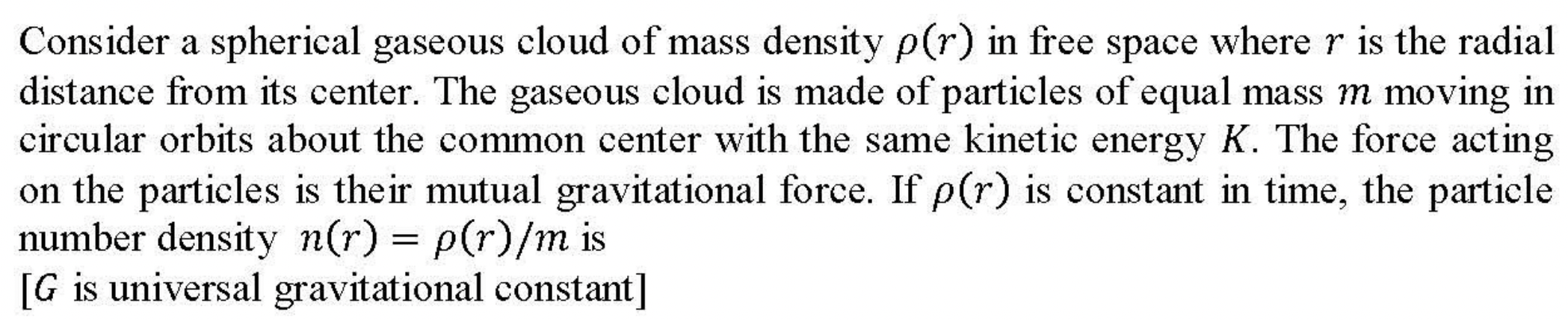
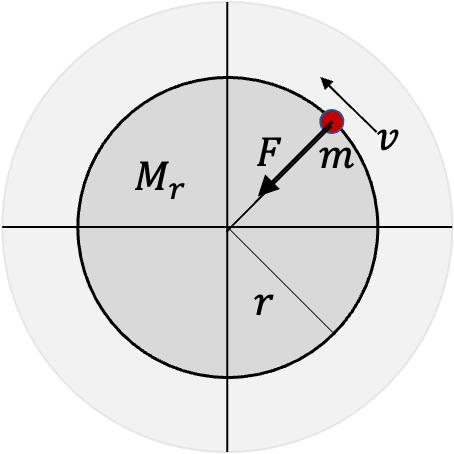
Figure 1.1.2 shows the situation for a particle of mass \(m\) moving at radius \(r\) of the spherical mass distribution. The force on \(m\) will be mass \(M_r\) that is inside the sphere of radius \(r\)
First let \(Q\) be the charge on the spherical shell without the hole. Since we have spherical symmetry, we can pretend all the charges at the center and potential of such a point charge at a distance \(R\) will give us the amount of charge on the shell. Thus,
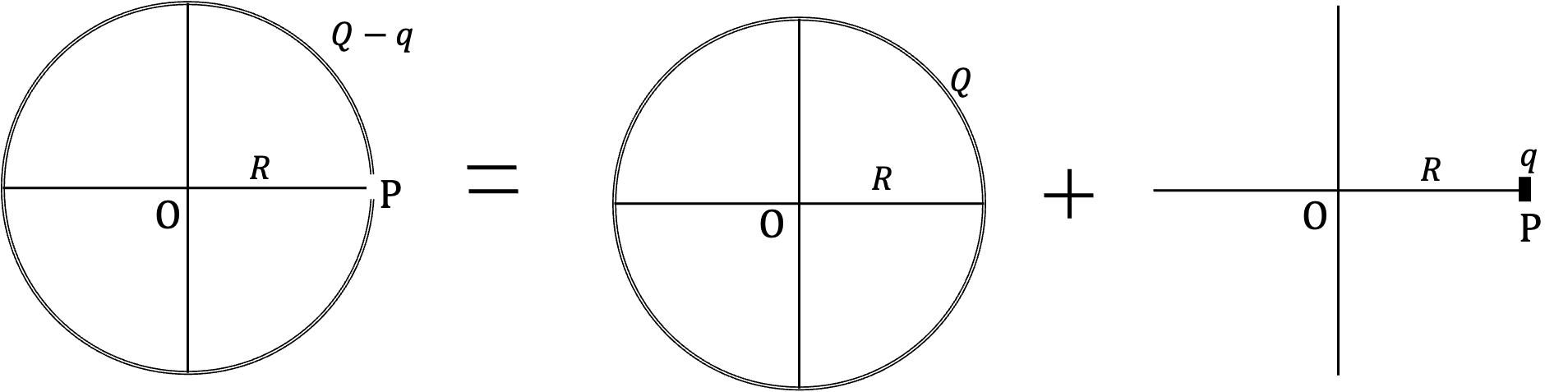
Second thing to notice is the potential and field of a charged shell with a tiny hole to be equal to the superposition of these quentities of (1) charged shell without the hole and (2) a point charge of the opposite sign at the point of the hole.
Since \(Q\) is distributed over the area \(A=4\pi R^2\) and hole has area \(a=\alpha 4\pi R^2\text{,}\) the point charge we need in Figure 1.1.4 is negative of \(Q\) and equal to
The potential at midway to the center will be a sum of the original and the change due to \(q\text{.}\) Change will be the potential due to \(q\text{.}\)
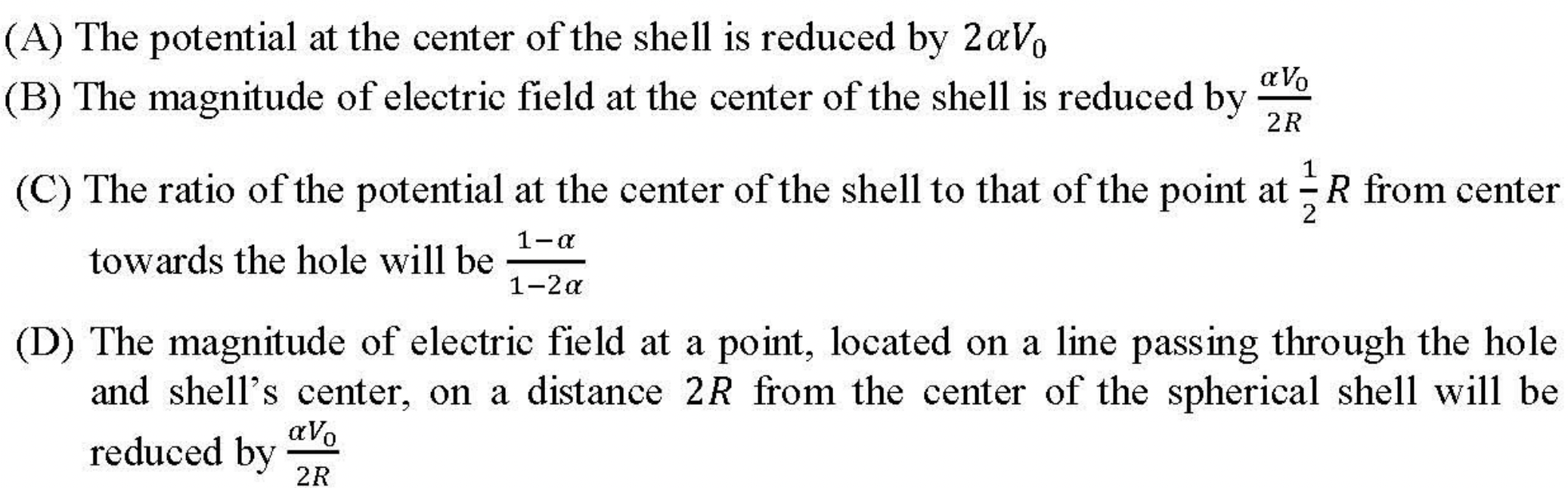
Comparing this to the given answer shows that (C) is correct. Since, we found the correct choice in a single correct choice question, we don’t need to look at (D), which should be incorrect. But, just in case, I will check that also.
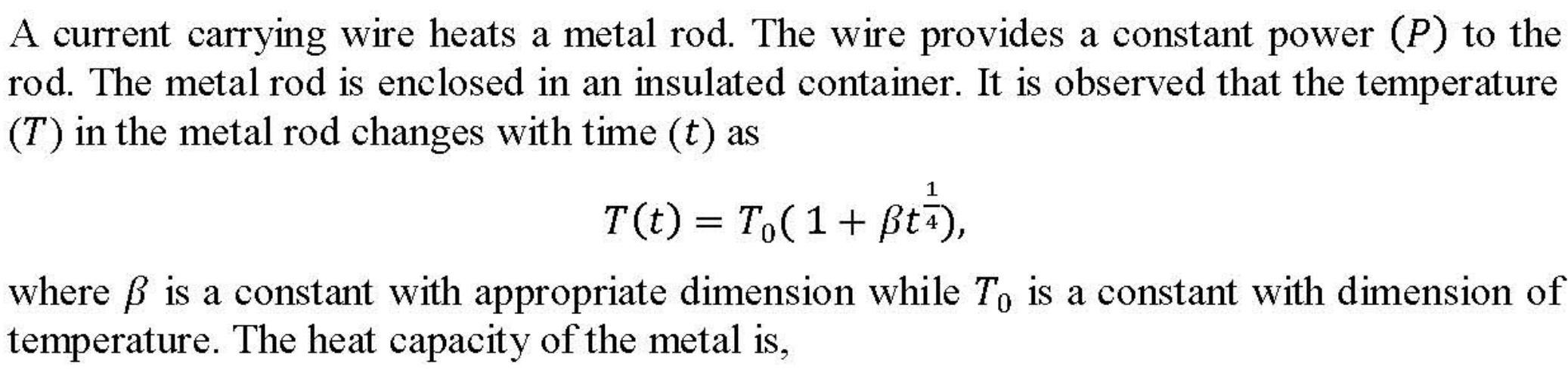
All the energy entering the metal in time \(dt\) goes towards raising its temperature by \(dT\text{.}\) Let \(C\) be the specific heat of the metal and \(m\) be its mass. Then, we have
\begin{equation*}
m C dT = P dt \ \ \longrightarrow\ \ m C \frac{dT}{dt} = P.
\end{equation*}
We have been given \(T(t) = T_0\left( 1 + \beta t^{1/4}\right)\text{.}\) Using that
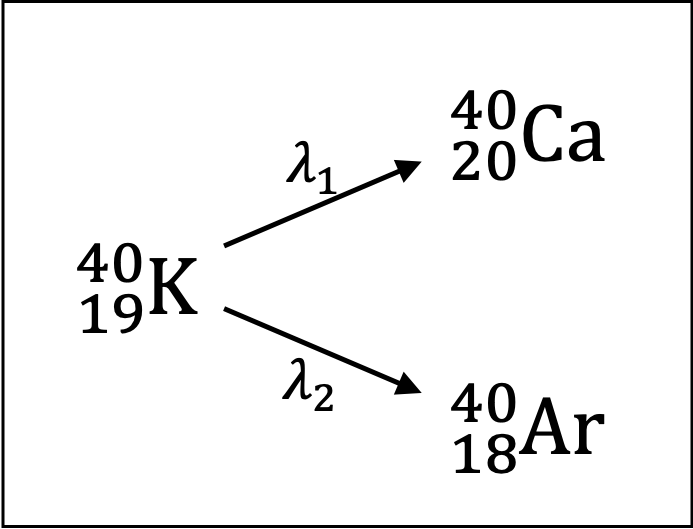
There are two modes of decay as shown in Figure 1.1.7. In such scenario, effective decay constant is sum of the decay constants of all the modes. Thus, number of \(^{40}_{19}\text{K}\) left after time \(t\text{,}\)\(N_t\) will be
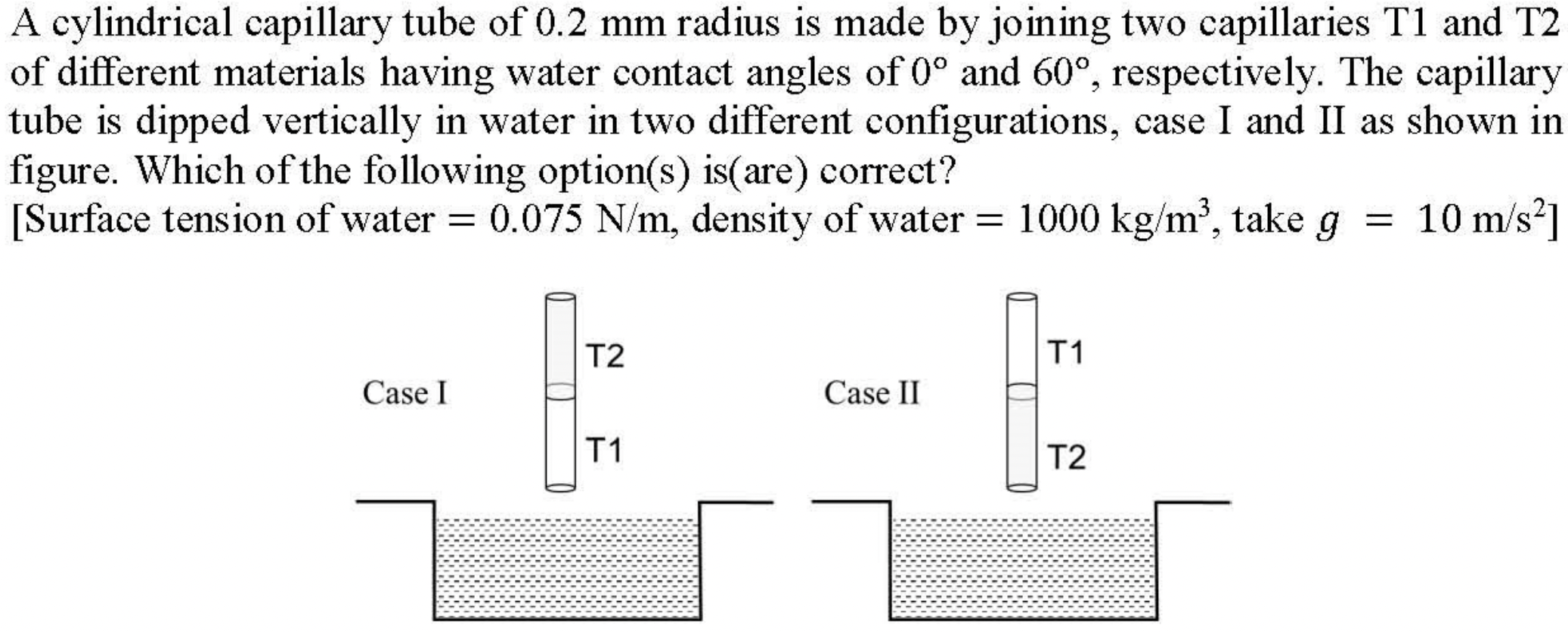
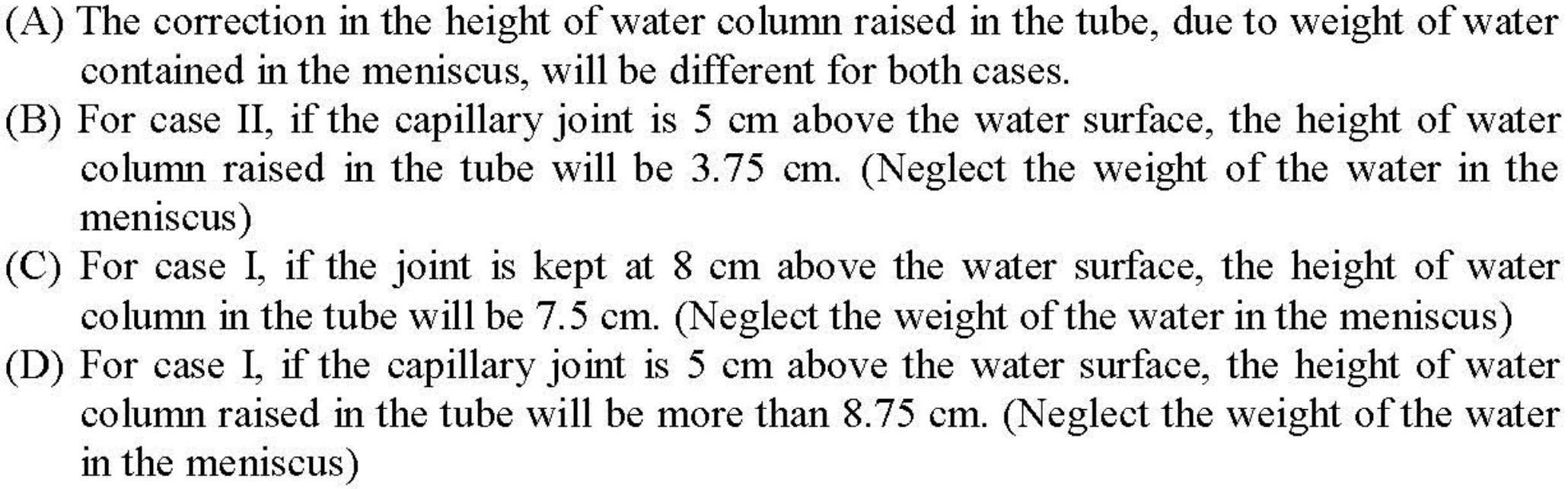
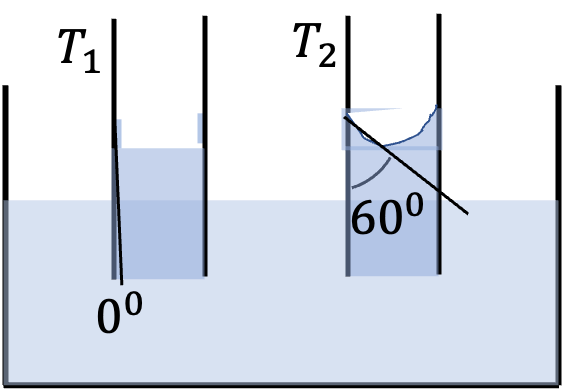
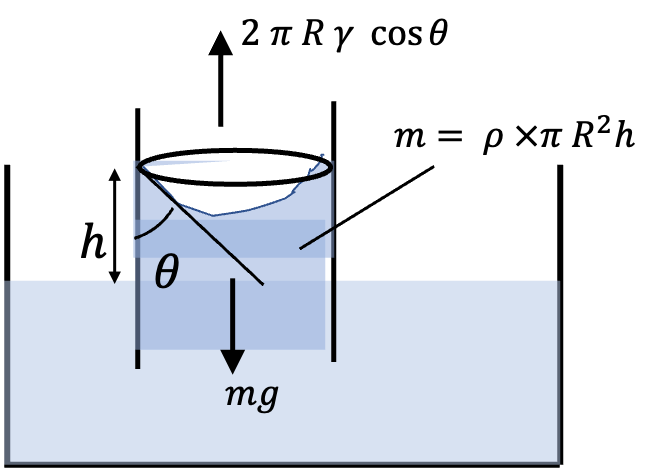
(A): As Figure 1.1.9 shows the meniscus of tube \(T_2\) will contribute more to the weight balanced by the surface tension. Hence, the correction to the height formula will be different. That is, (A) is correct.
For (D), since available height is only \(5\text{ cm}\) while in tube of type \(T_1\text{,}\) we expect to rise to height \(7.5\text{ cm}\) before it encounters a tube of contact angle that is larger. The liquid will stop at height of \(5\text{ cm}\) as we can easily show.
Let the liquid rises by a height \(y\) in tube \(T_1\) abive the \(5\text{ cm}\text{.}\) The surface tension will correspond to \(\theta=0\) since it is the tube at the top. The surface tension must support a height of \(5\text{ cm} + y\) with \(y \ge 0\text{.}\) Thus, we require
\begin{equation*}
\rho \pi R^2 (0.05 + y) g = 2\pi R \gamma\cos 60^\circ.
\end{equation*}
Solve for \(y\) to get
\begin{equation*}
y = \frac{2 \gamma }{\rho g R}\, \cos 60^\circ - 0.05 = 0.0375 - 0.05 \lt 0.
\end{equation*}
That is not possible. Hence choice (D) will be incorrect.
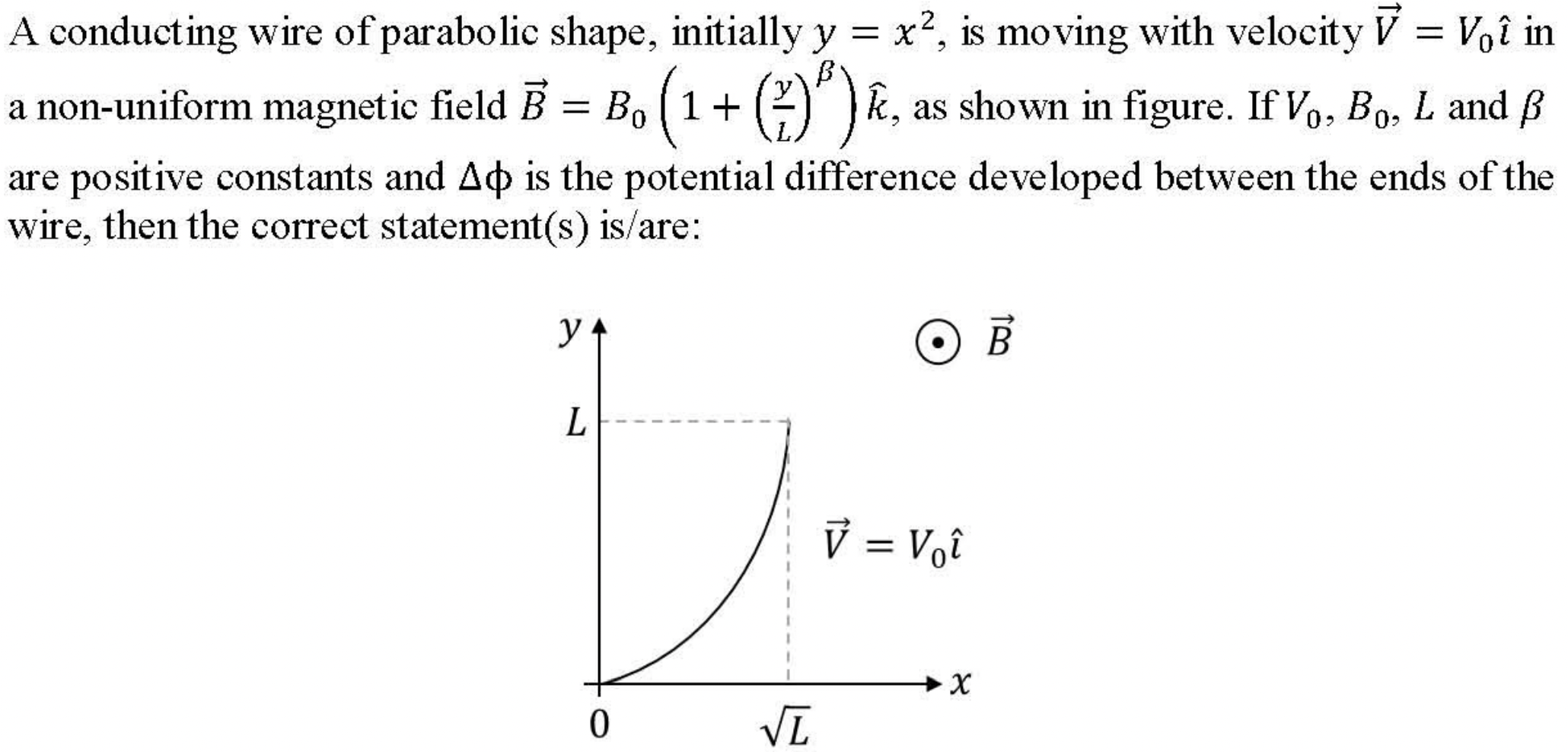
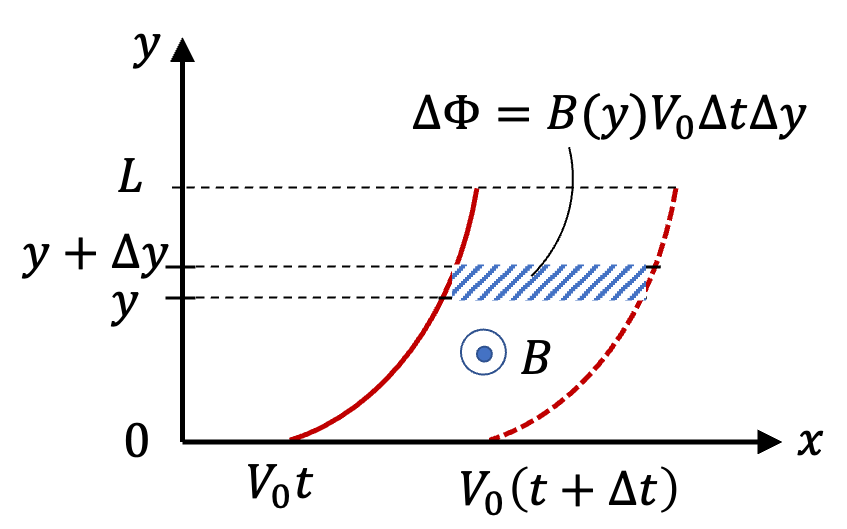
This is clearly a Faraday’s law problem. We want rate of flux change. For that we need to compute change in flux between instant \(t\) and \(t+\Delta t\text{.}\) Since \(B\) is a function only of \(y\text{,}\) we pick a strip between \(y\) and \(y+\Delta y\) as shown in Figure 1.1.12.
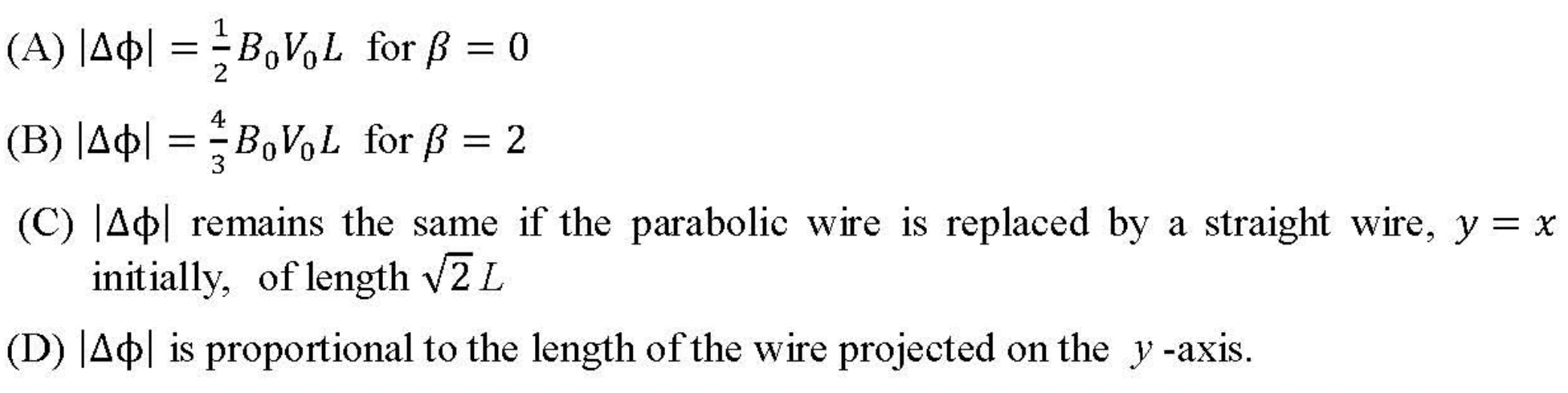
(B): To check (B), we set \(\beta = 2\) in Eq. (1.1.3). This gives induced EMF to be \(\dfrac{4}{3}B_0V_0L\text{,}\) which means choice (B) is correct.
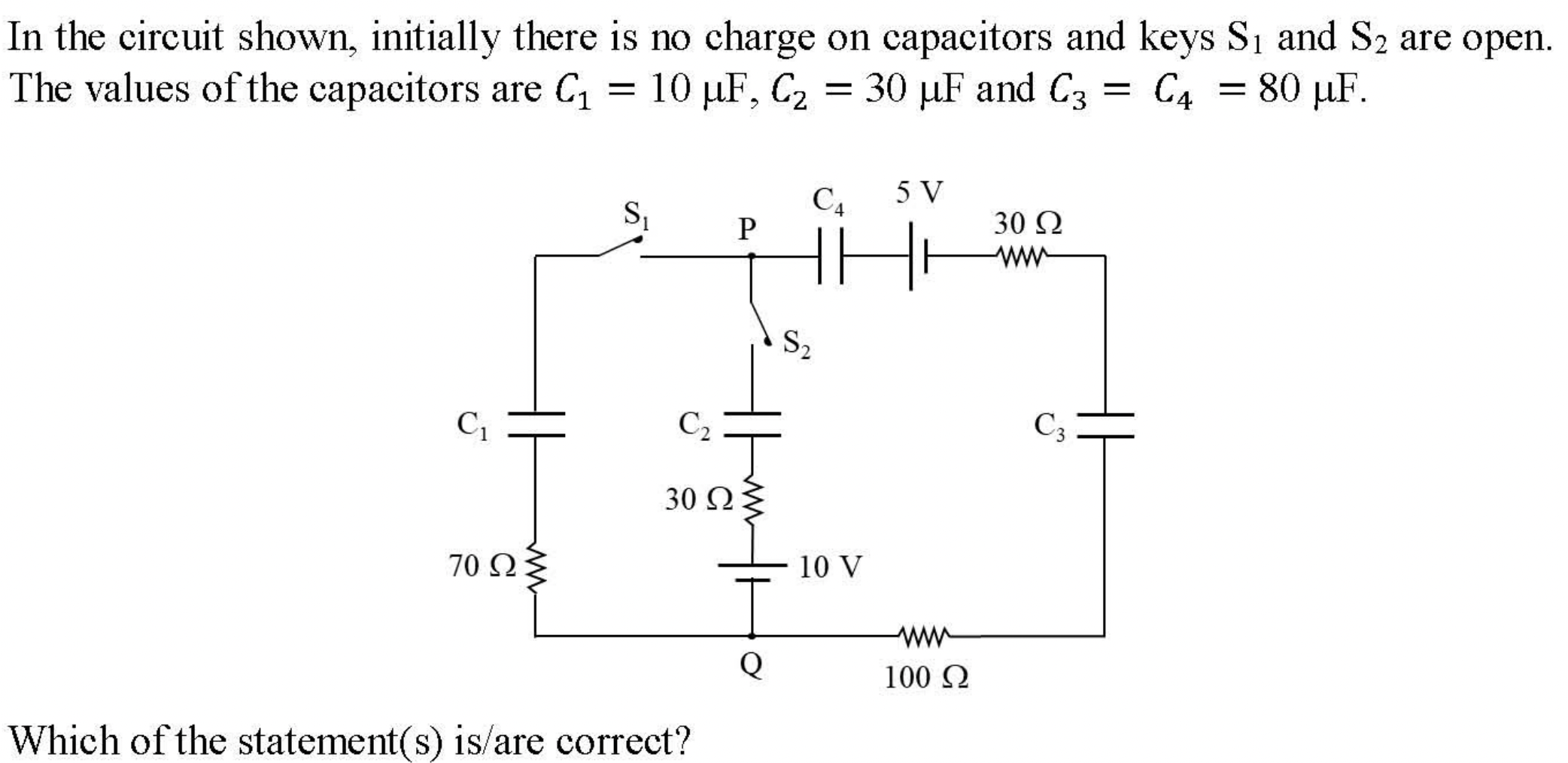
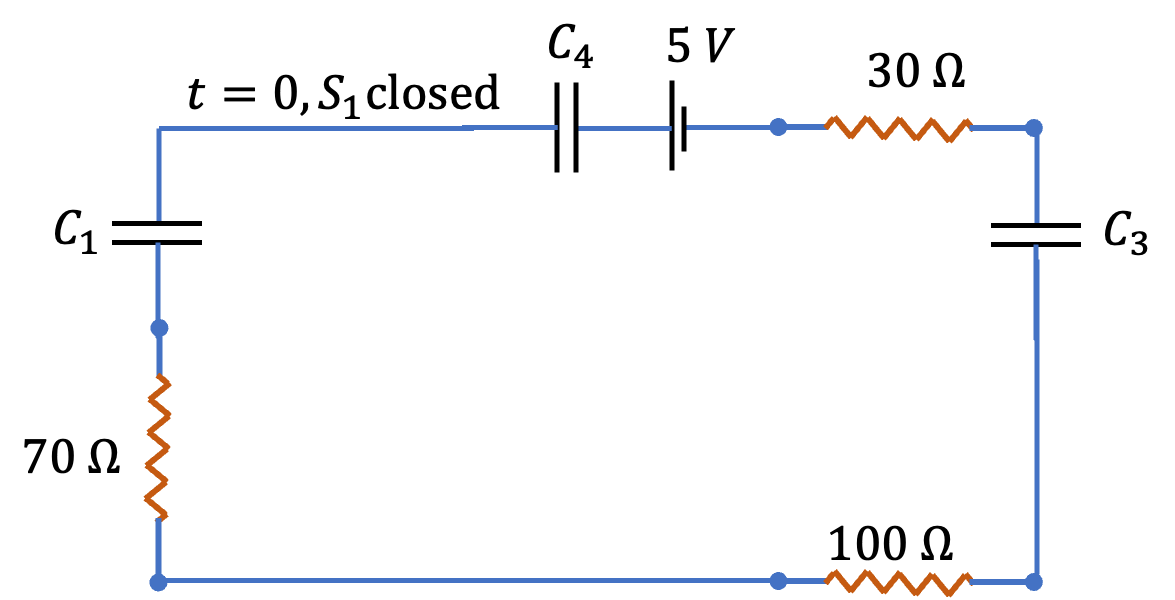
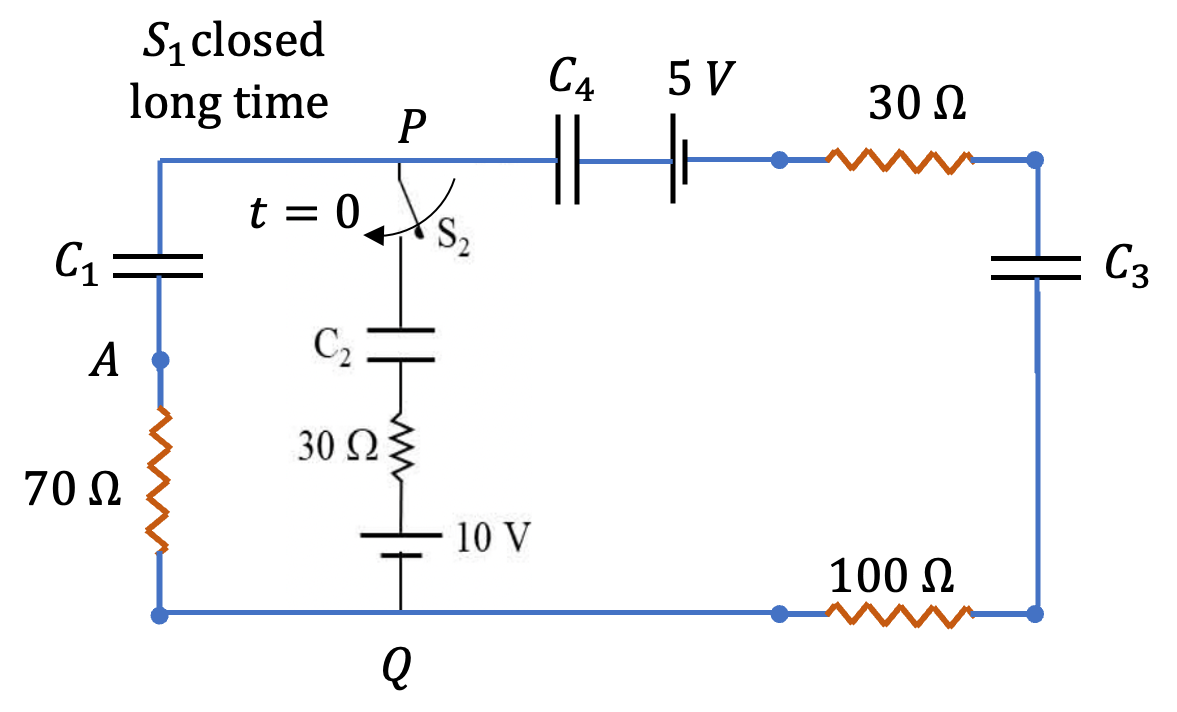
(A) & (B): Since switch \(S_2\) is open for these parts, that branch is not in the circuit. Figure 1.1.14 shows the simplified circuit for this part. All circuit elements are in series and they can be simplified to obtain equivalent quantities.
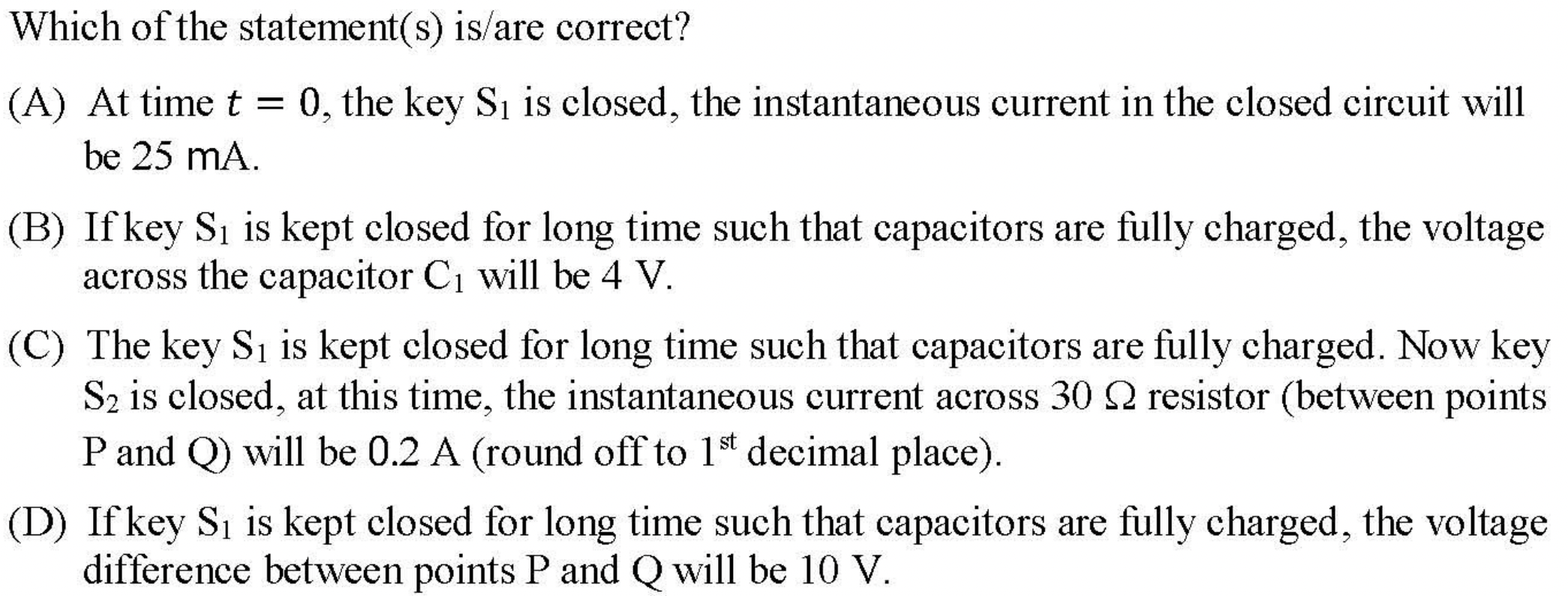
(A) is asking for current just when switch \(S_1\) was closed. At that time, no charge was built on capacitors. So, capacitors are like shorts. There is only voltage source, net voltage across the equivalent resitance is the voltage of that source.
(B) is asking for voltage across capacitor \(C_1\) when all capacitors are fully charged. At that point there will ne no current and hence no drop in voltage across the resistors. Using equivalent capacitance in capacitor formula we can find the charges on the equivalent capacitor. But since capacitors are all in series, they will all have the same charge.
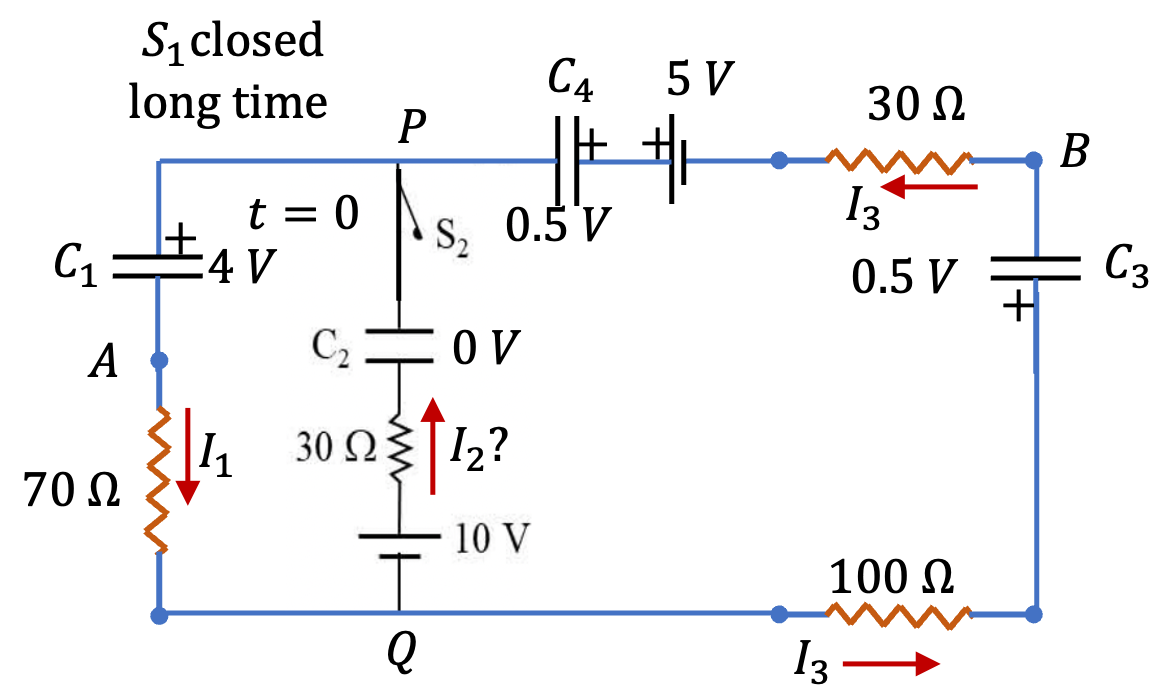
(C) & (D): Since switch \(S_1\) was open for a long time, capacitors \(C_1\text{,}\)\(C_3\) and \(C_4\) are charged at the instant \(S_2\) is closed. We mark this instant to be new \(t=0\) as shown in Figure 1.1.15.
(C): This is after switch \(S_2\) is closed when capacitors \(C_1\text{,}\)\(C_3\) and \(C_4\) are fully charged and capacitor \(C_2\) is uncharged. That will mean capacitors \(C_1\text{,}\)\(C_3\) and \(C_4\) will be voltage sources and capacitor \(C_2\) will be just a short. The circuit with labels is shown in Figure 1.1.16.
This shows that given answer of \(0.2\text{ A}\) is not correct. Incidently, if you ignore any current in the outer loop as was the case when only switch \(S_1\) was closed, you would get \(0.2\text{ A}\text{,}\) but that isn not the situation at an instant after \(S_2\) is closed.
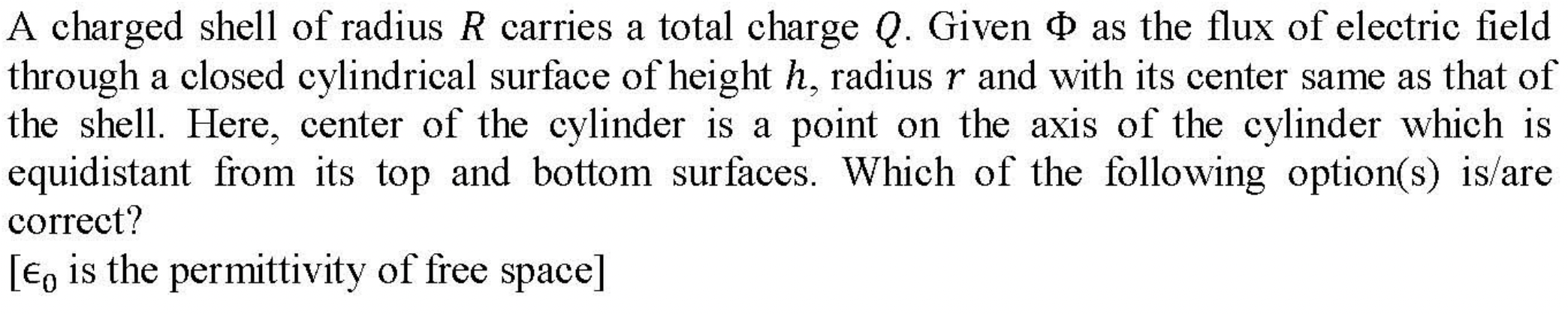
Think of the surface of the cylinder in these problems as Gaussian surface and use Gauss’s law for them. Recall that Gauss’s law states that electric flux through a closed surface \(S\) will be
\begin{equation*}
\Phi = \oint_S \vec E \cdot d\vec A = \frac{Q_\text{enclosed}}{\epsilon_0}.
\end{equation*}
(A): Since entire charged spherical shell is within the space enclosed by the surface of this cylinder, \(Q_\text{enclosed} = Q\text{.}\) Hence, flux through this surface will be \(\Phi = Q/\epsilon_0\text{,}\) which is the given answer. So, (A) is correct.
(B): Since entire charged spherical shell is outside the space enclosed by the surface of this cylinder, \(Q_\text{enclosed} = 0\text{.}\) Hence flux through this surface will be \(\Phi = 0\text{,}\) which is the given answer. So, (B) is correct.
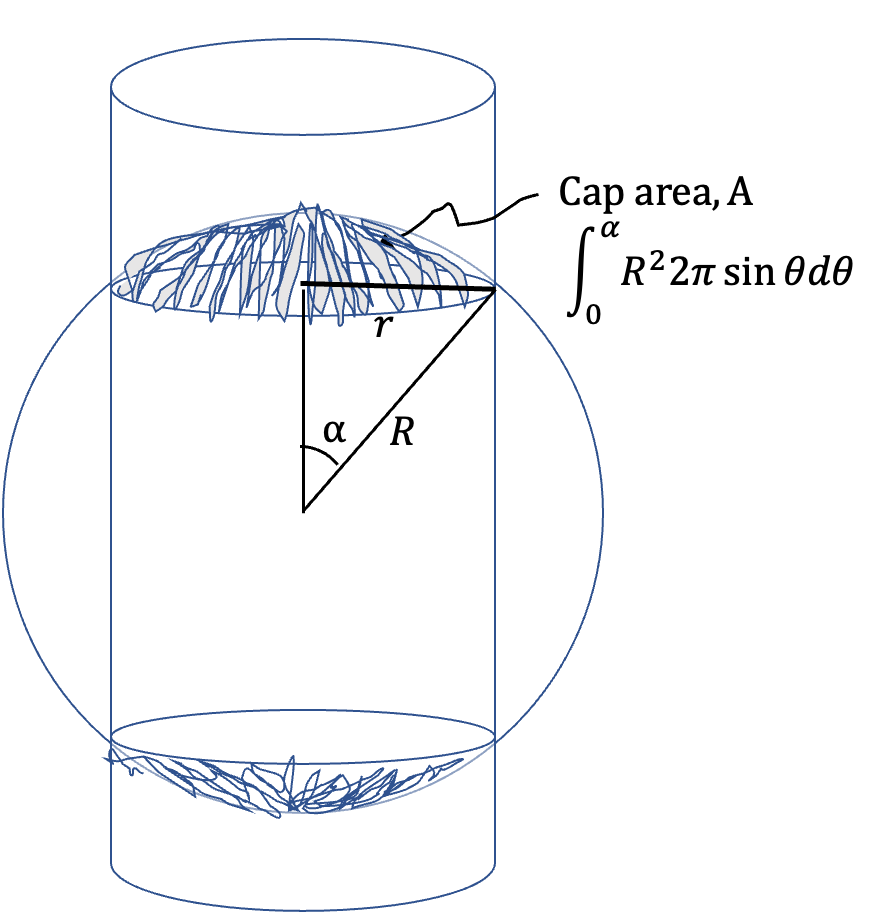
(C): The cylinder now cuts through the sphere as shown in Figure 1.1.18. The enclosed charges are now on the two spherical caps shown. Area of each cap is
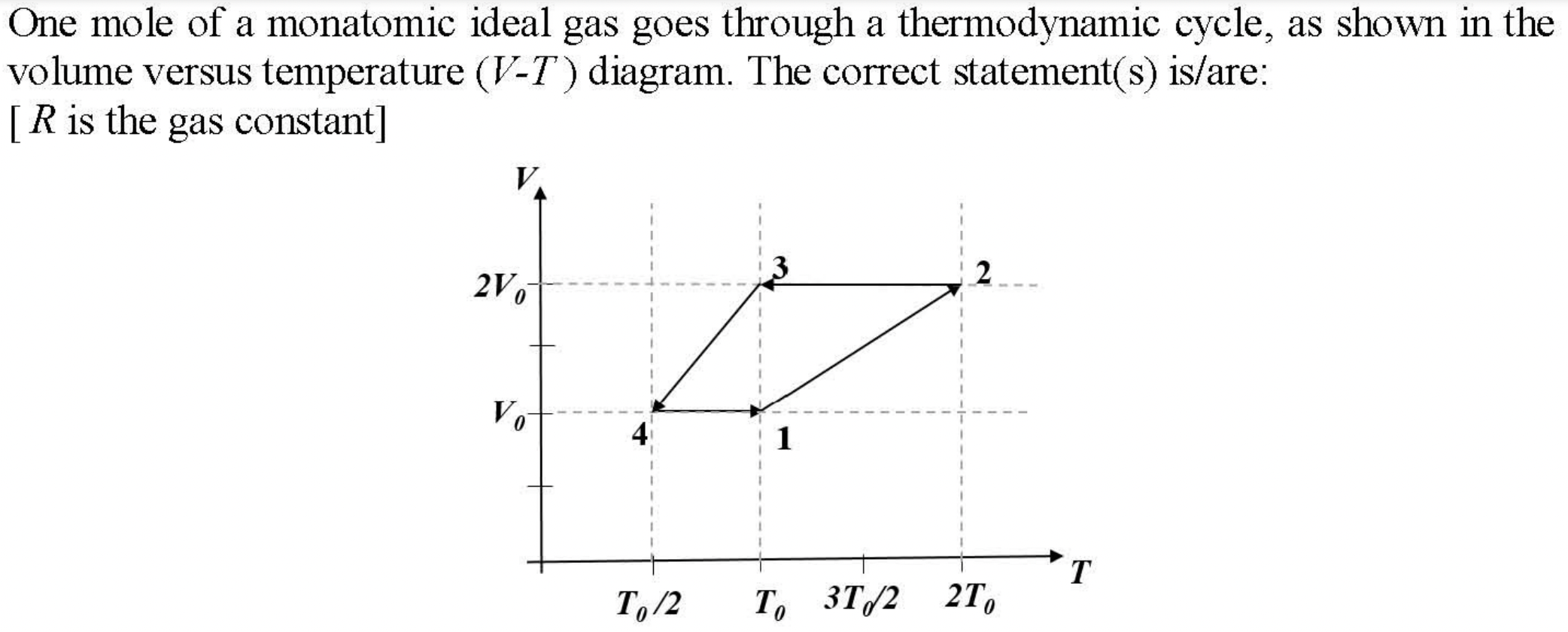
(A): Work around the cycle will be sum of work for each process. We need a formula for work in \((T, V)\) plane for an ideal gas. We get that from \(pdV\text{.}\)
\begin{equation}
W_{ab} = \int_a^b p dV = \int_a^b \frac{nRT}{V} dV = nR \int_a^b \frac{T(V)}{V} dV,\tag{1.1.7}
\end{equation}
where I have kept \(T\) inside the integral since we will have \(T\) vary as a function of \(V\text{.}\) In process \(1\rightarrow 2\) process
\begin{equation*}
V - V_0 = \frac{V_0}{T_0}\left( T - T_0\right)\ \ \longrightarrow\ \ T = \frac{T_0}{V_0} V.
\end{equation*}
Therefore, work in this step will be (with \(n=1\))
\begin{equation*}
W_{12} = R \int_1^2 \frac{T_0}{V_0} dV = R \frac{T_0}{V_0} (2 V_0 - V_0 ) = RT_0.
\end{equation*}
In process \(2\rightarrow 3\text{,}\) since \(dV=0\text{,}\) we will have zero work.
\begin{equation*}
W_{23} = 0.
\end{equation*}
In process \(3\rightarrow 4\text{,}\) the equation of the line is
\begin{equation*}
V - 2V_0 = \frac{2V_0}{T_0}\left( T - T_0\right)\ \ \longrightarrow\ \ T = \frac{T_0}{2V_0} V.
\end{equation*}
Therefore, work in this step will be
\begin{equation*}
W_{34} = R \int_3^4 \frac{T_0}{2V_0} dV = R \frac{T_0}{2V_0} (V_0 - 2V_0 ) = -\frac{1}{2}RT_0.
\end{equation*}
In process \(4\rightarrow 1\text{,}\) since \(dV=0\text{,}\) we will have zero work.
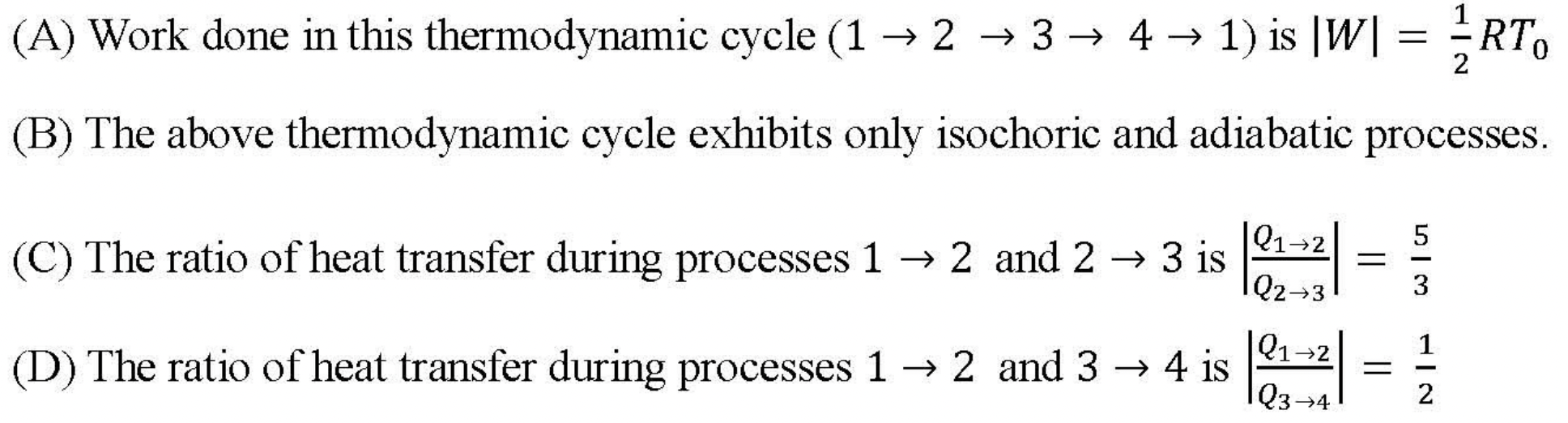
(B) We know that processes \(2\rightarrow 3\) and \(4\rightarrow 1\) are isochoric. We need to check if other processes are adiabatic. Let’s clculate heat involved in process \(1\rightarrow 2\) and \(3\rightarrow 4\text{.}\) First law for a process says
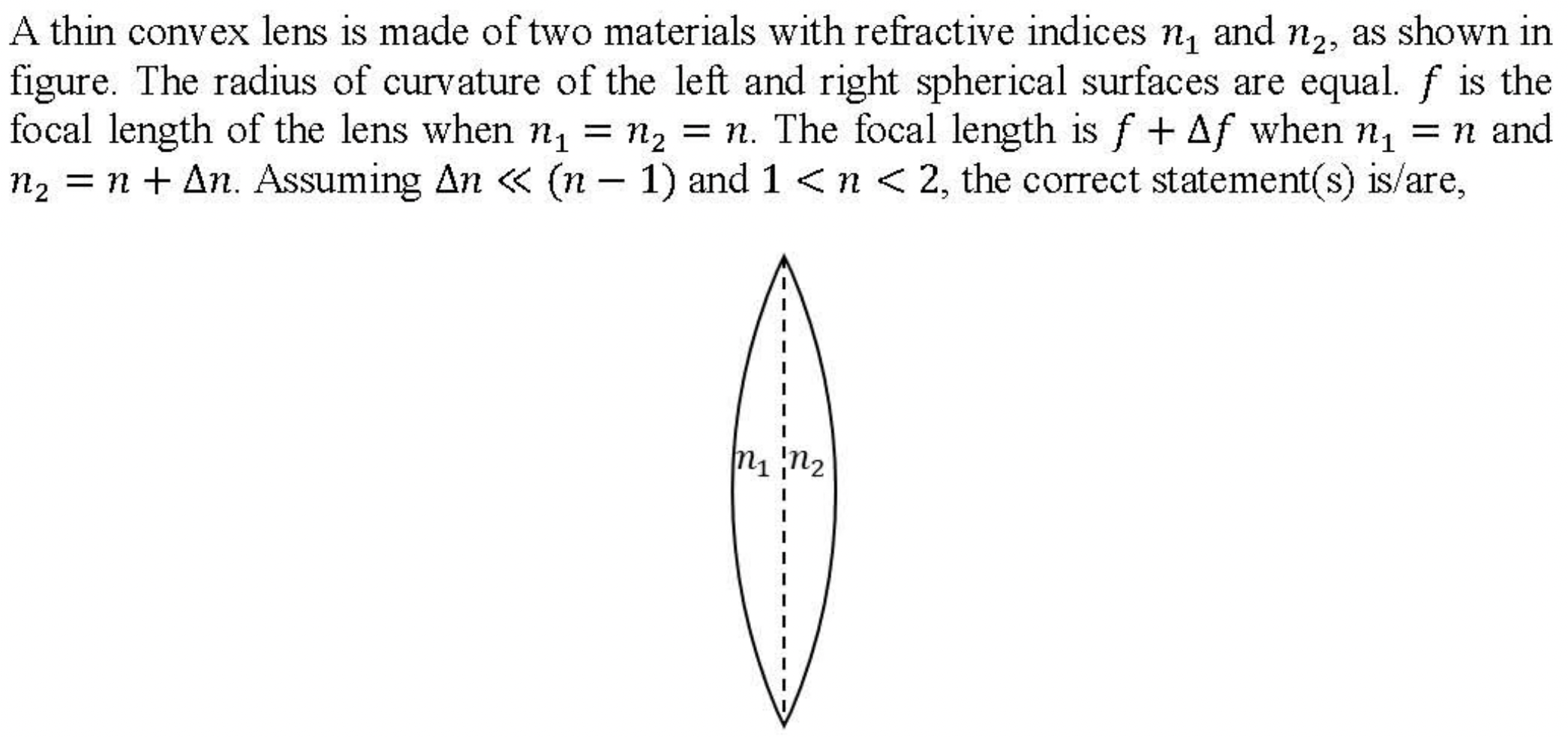
Now, given lens is a composite lens of two plano-convex lenses stacked against each other. Since we are working in thin lens approximation, the inverse of equivalent focal length of the two will be
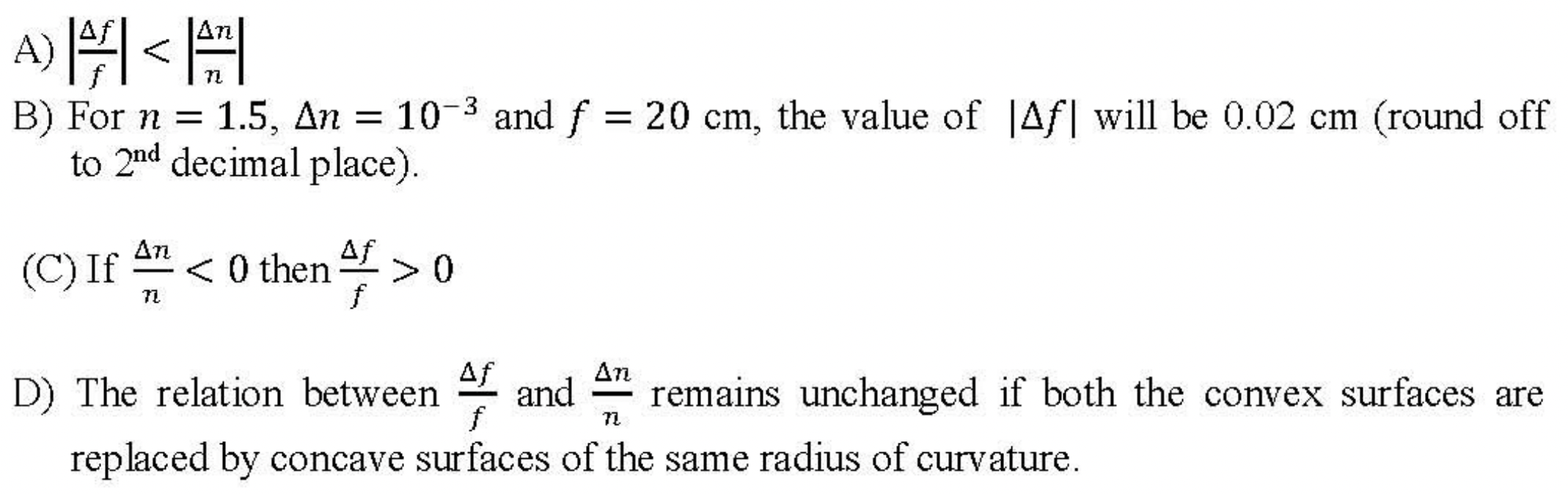
To decide on the answer, we need to check whether the factor on the right side is less than or greater than 1. Since \(1 \lt n \lt 2\) let us replace \(n\) by \(1+\epsilon\text{.}\)
(D): In my derivation of Eq. (1.1.8), \(R\) canceleld out in the ratio. So, not only replacing with concave surface but also any other \(R\) would give the same result as long as thickness \(d \ll R\text{.}\) So, given choice (D) is correct.
Problem1.1.22.Q12. Ammeter and Voltmeter from a Galvanometer.
Hint.
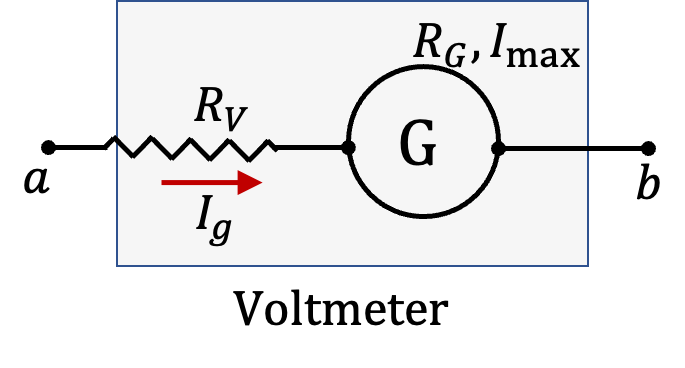
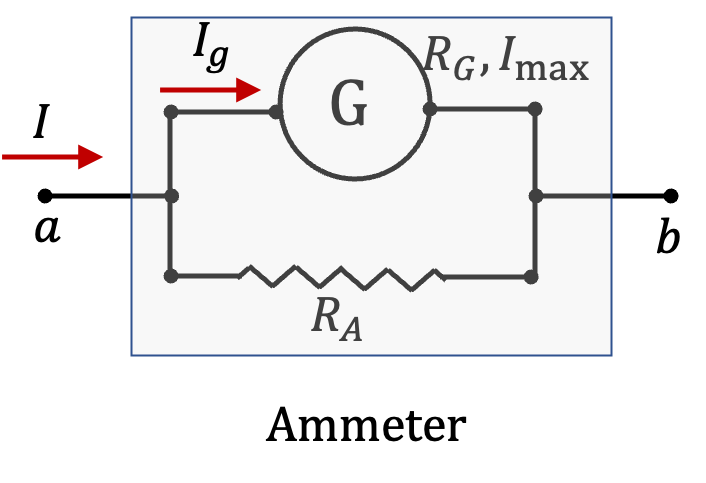
Galvanometer is used as a voltmeter by attaching a suitable resistor in series to the galvanometer. To use a galvanometer as as ammeter, you attach a suitable resistor in parallel to the galavnometer.
Figure 1.1.23 shows a galvanometer used as ammeter by using an appropriate shunt resistor \(R_A\) and as a voltmeterby using appropriate resistor \(R_V\) in-series.
The voltmeter is to read \(100\text{ mV}\) between ends a and b at full deflection, i.e., when current through the galvanometer is max for the galvanometer. Therefore, in the voltmeter, we will have
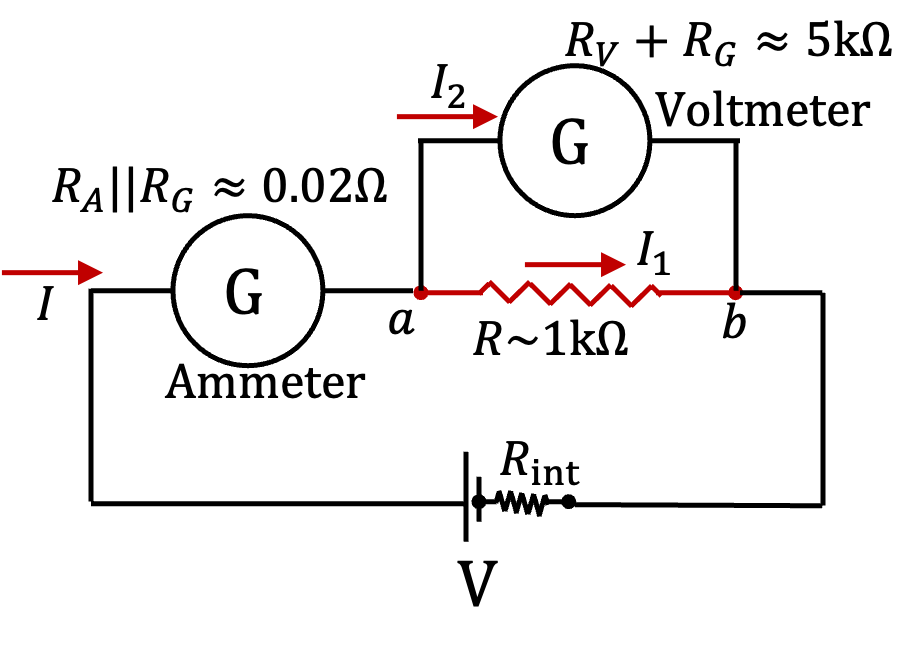
(C) & (D): These are for a circuit that measures an unknown resistance by measuring current an voltage readings in an Ohm experiment shown in Figure 1.1.24.
(D): The answer given is incorrect since as shown in (C) above that experimental value of \(R\) depends upon ratio of \(I_1\) and \(I\text{,}\) which is indepdenent of internal resistance.
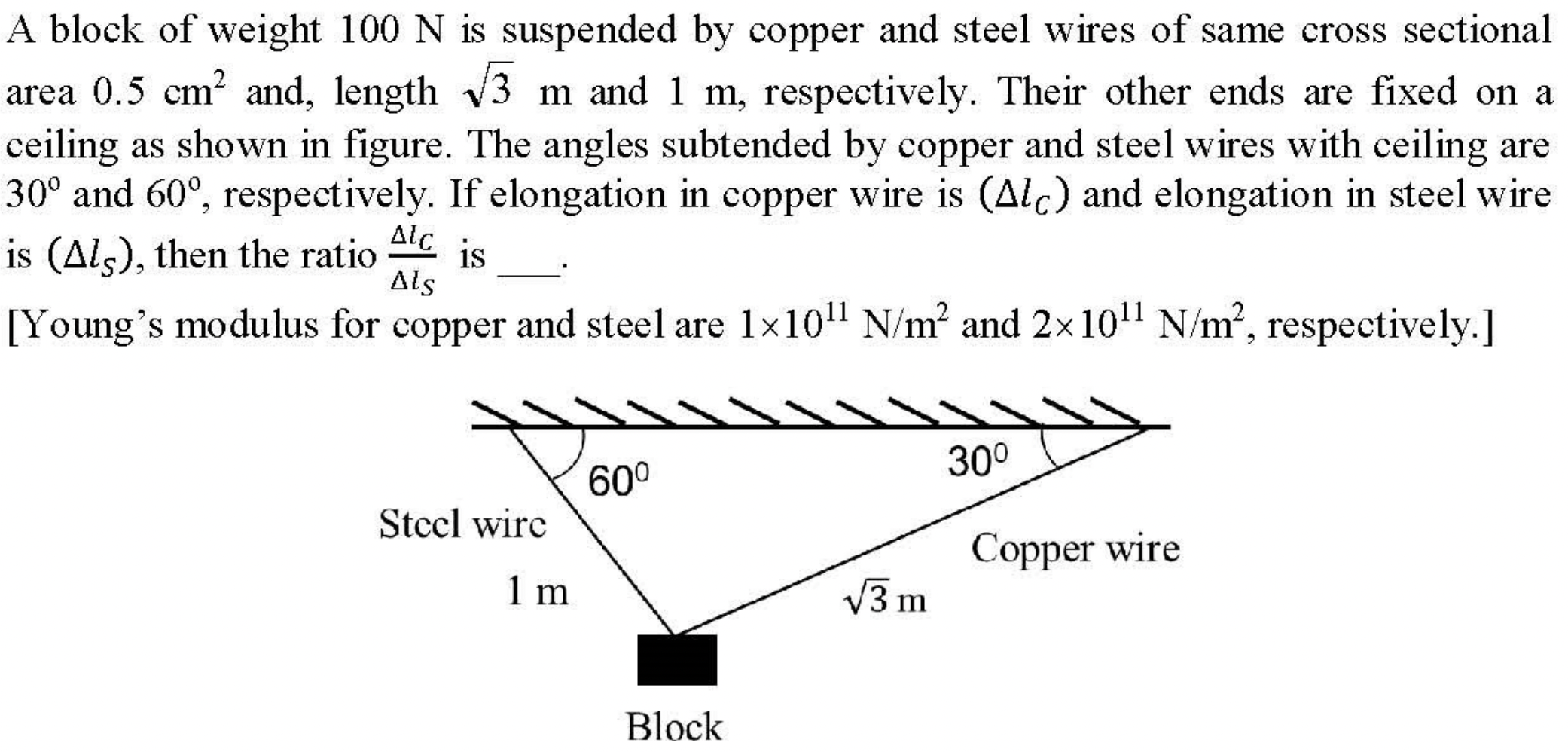
Let \(T_1\) be tension in steel and \(T_2\) the tension in copper cable. Denote by \(l_1\) and \(l_2\) the lengths of steel and copper cables and \(A\) be the area of cross-section of the cables. Since they have the same cross-section, we use one symbol. Then by Hooke’s law
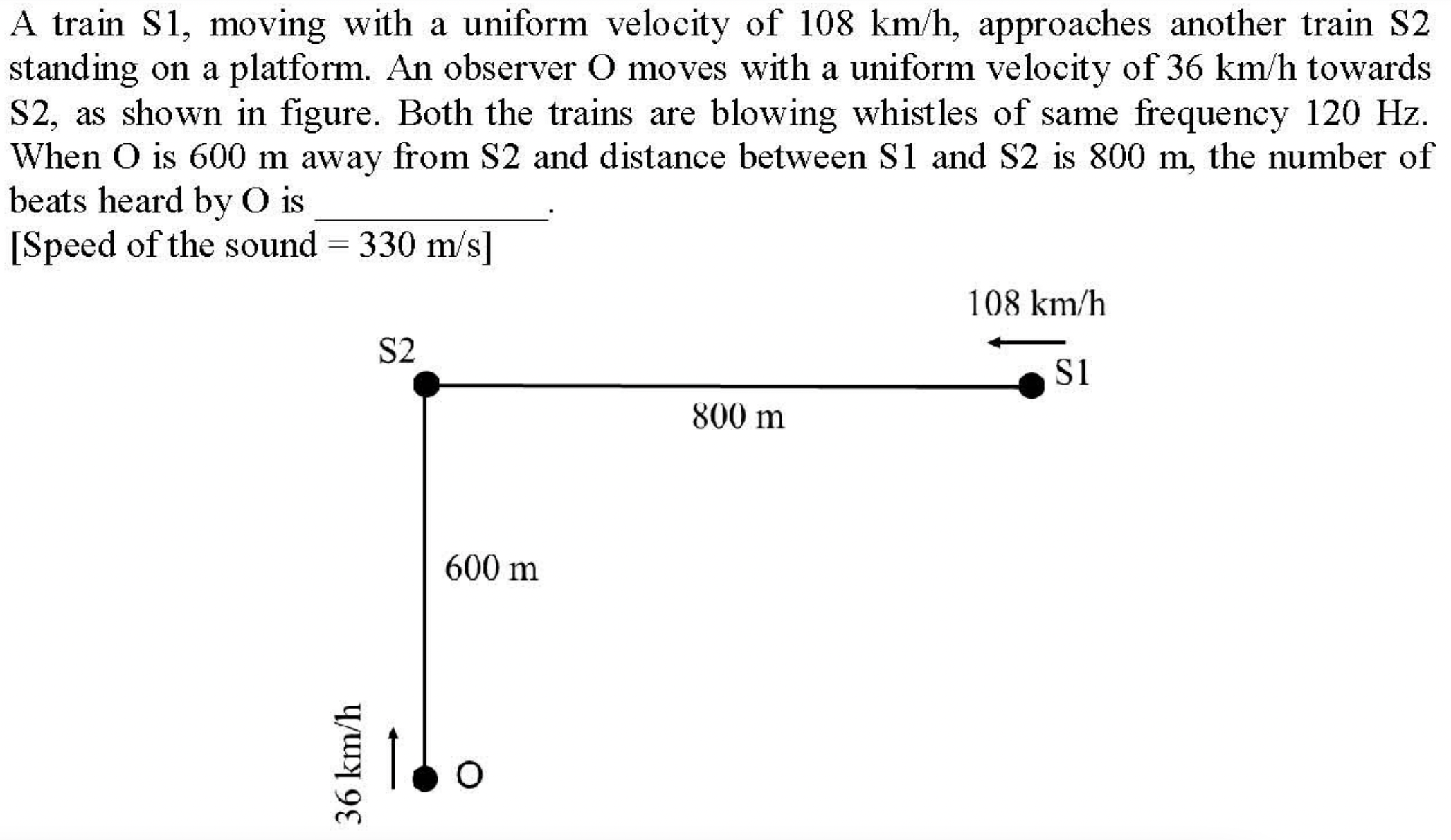
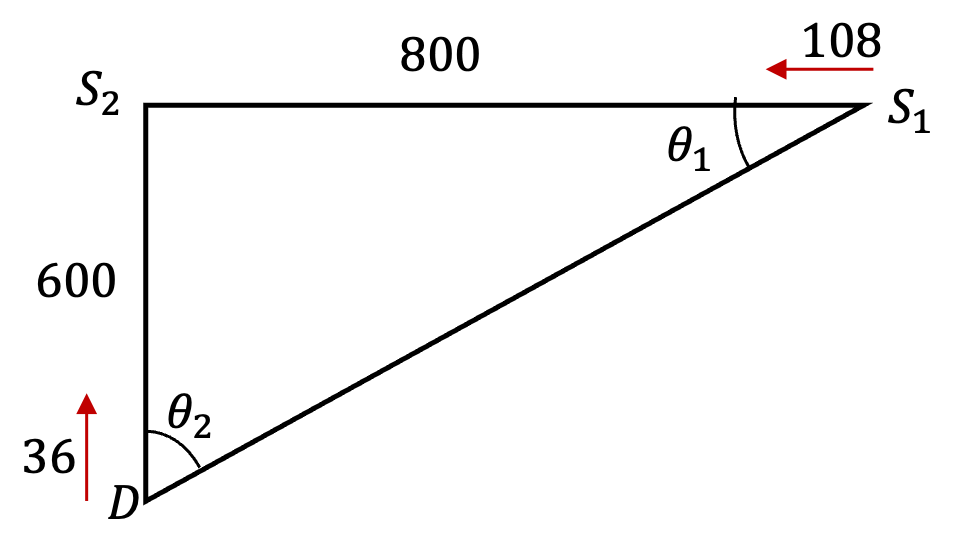
We are dealing with Doppler effect of sound. Let \(v_\text{source}\) be the velocity of the source towards the detector and \(v_\text{detector}\) be velocity of the detector towards the source, both with respect to the medium with convenstion that they are postive for component towards each other. Let \(v\) be thevelocity of the sound in the medium. Then frequency detected will be
\begin{equation*}
f = f_0 \left( \frac{v + v_\text{detector}}{ v - v_\text{source}} \right)
\end{equation*}
The beat frequency of two waves is \(f_\text{beat} = |f_1 - f_2|\text{.}\)
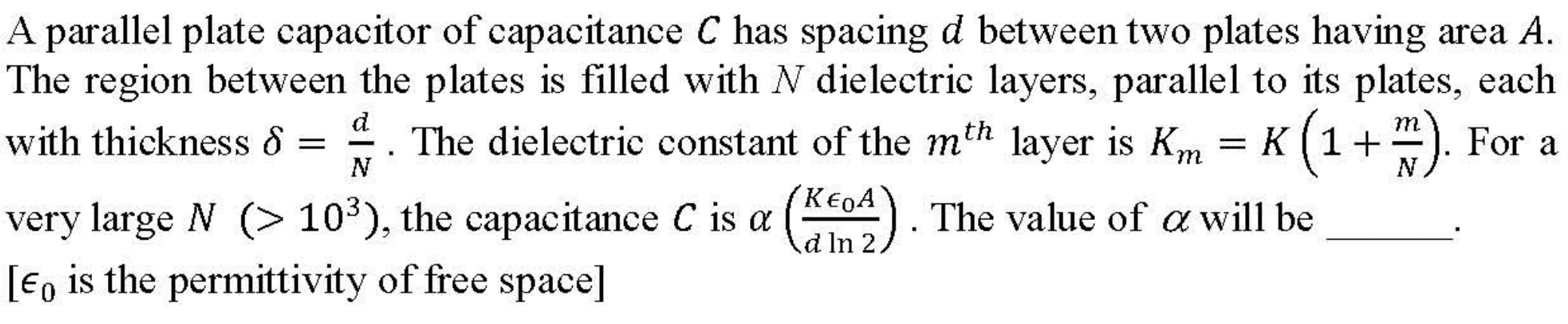
Let \(x= m/N\text{.}\) With \(N\delta = d\text{,}\) a fixed distance, as \(N\rightarrow \infty\text{,}\) distance between successive \(x\) points become infintisimally small and we can treat \(x\) as a continuous variable. The quantity in \([]\) can be replaced by the following integral.
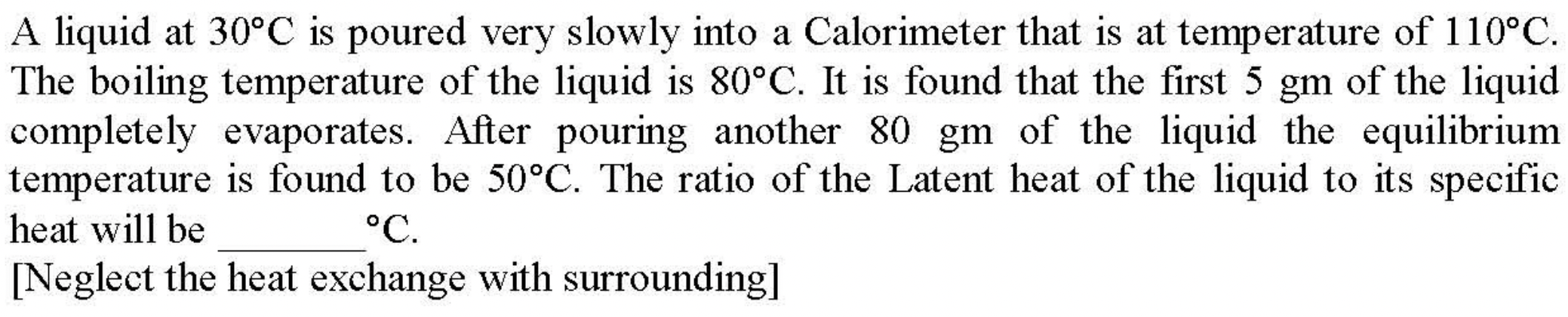
This problem is a problem of just accounting of energy. Let \(L\) denote the latent heat of evaporation and \(C\) the specific heat. Let \(C_0\) be specific heat of calorimeter and \(m_0\) its mass in grams.
First 5 g of liquid goes from \(30^\circ\) to \(80^\circ\) and then evaporates. During this time calorimeter’s temperature drops from \(100^\circ\) to \(80^\circ\text{.}\) This gives us one equation.
\begin{equation*}
5 (80-30) C + 5 L = m_0 C_0 (110 - 80).
\end{equation*}
Now, we have 80 gram of liquid going from \(30^\circ\) to \(50^\circ\) and calorimeter going from \(80^\circ\) to \(50^\circ\text{.}\) This gives
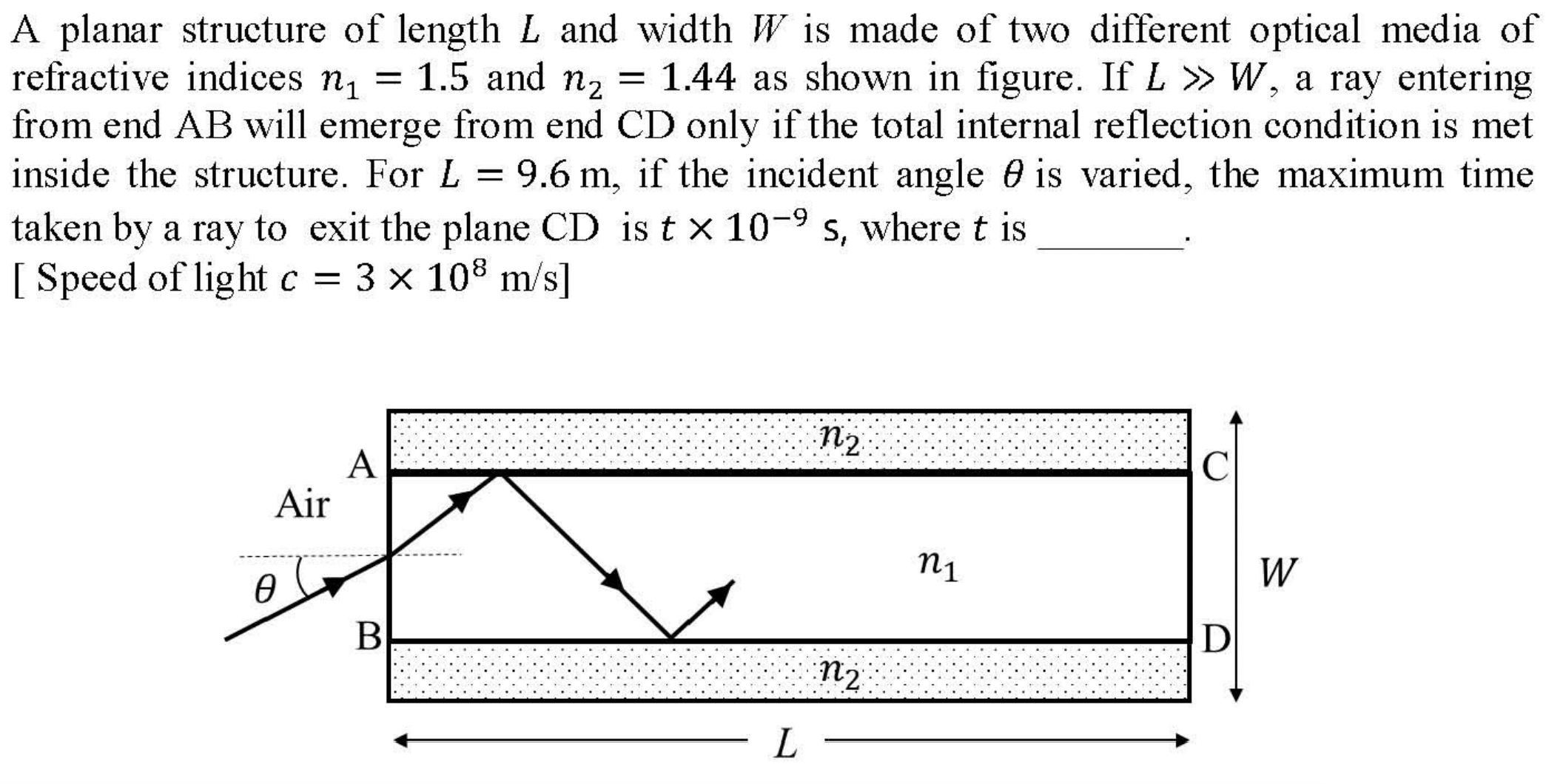
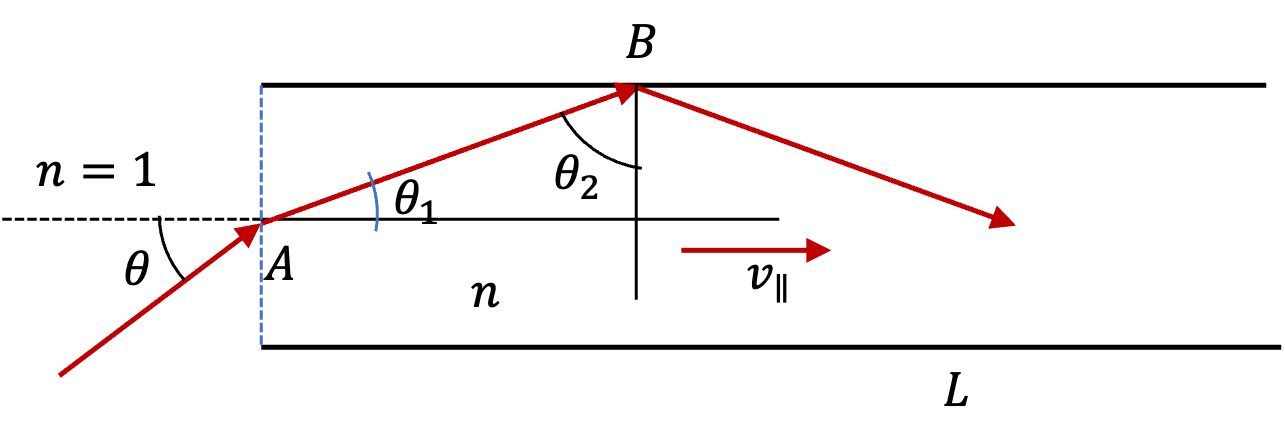
To find \(\cos\theta_1\) we note that max time will correspond to max \(\theta\) in the diagram. That is correspond to max \(\theta_1\) so that reflection at B is a total internal reflection.