Problem 1.2.1. Q1. Rotation of a Rod About its Edge.

Solution.
We will use Figure 1.2.2 to do our calculations. The figure shows the three forces on the rotating rod. To get angular speed, we will use energy conservation. To get angular acceleration, we will use \(I\alpha = \tau\) for ration about O. To find \(F_N\text{,}\) we will set up \(F_y = m a_y\text{,}\) where \(a_y\) will be obtained from centripetal \((a_c)\) and tangental \((a_t)\) accelerations.
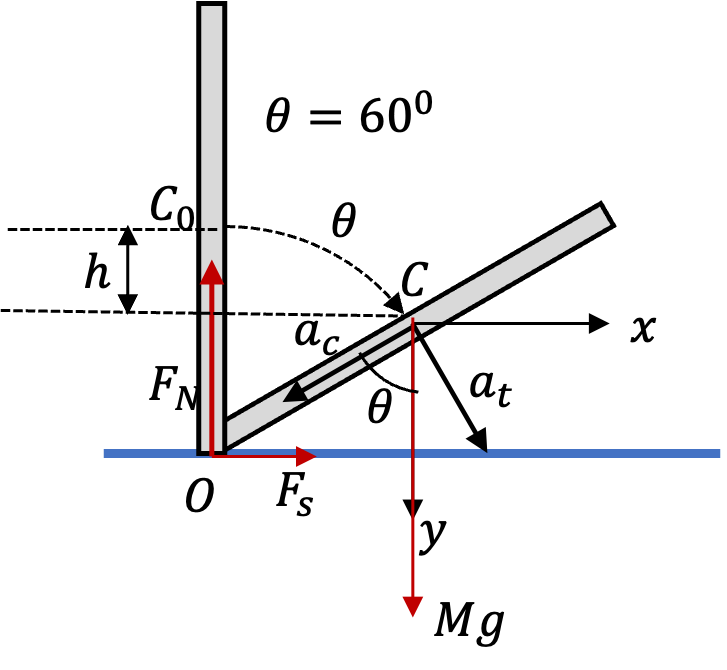
(A): Potential enegry drop is due to CM falling by height \(h\text{,}\) which will be
\begin{equation*}
h = \frac{L}{2} - \frac{L}{2} \cos\theta.
\end{equation*}
Kinetic energy will be rotational kinetic energy about \(O\text{.}\) Since that is the end of the rod, moment of inertia will be
\begin{equation*}
I = \frac{1}{3} M L^2.
\end{equation*}
Let \(\omega\) be angular velocity when at angle \(\theta\text{.}\) Energy conservation gives
\begin{equation*}
\frac{1}{2} I \omega^2 = M g h.
\end{equation*}
Hence,
\begin{equation*}
\omega^2 = \frac{2 Mg \frac{L}{2} \left(1 - \cos\theta \right)}{ \frac{1}{3} M L^2 } = \frac{3 g \left(1 - \cos\theta \right)}{L}.
\end{equation*}
With \(\theta = 60^\circ\text{,}\) ie., \(\cos\theta = \frac{1}{2}\text{,}\) this gives
\begin{equation*}
\omega = \sqrt{ \frac{3 g}{2 L} }.
\end{equation*}
Hence choice (A) is correct
(B): To get angular acceleration, we apply \(I\alpha = \tau\) about O. The torque about O will be only from \(Mg\) at the CM with lever arm \(\frac{L}{2}\sin\theta\text{.}\) Therefore,
\begin{equation*}
\alpha = \frac{Mg\frac{L}{2}\sin\theta}{\frac{1}{3} M L^2} = \frac{3\sqrt{3}g}{4L}.
\end{equation*}
Hence, choice (B) is in correct.
(C): Since CM is moving in a circle of radius \(L/2\) with angular speed \(\omega\text{,}\) radial acceleration, i.e., centripetal acceleration, of CM will be
\begin{equation*}
a_c = \omega^2 \frac{L}{2} = \frac{3 g}{2 L} \times \frac{L}{2} = \frac{3 g}{4}.
\end{equation*}
Hence, (C) is correct.
(D): To set up \(F_y = m a_y\text{,}\) we need \(a_y\text{,}\) which can be obtained from \(y\)-component of centripetal acceleration \(a_c\text{,}\) which we already foubnd in (C), and tangential acceleration \(a_t\text{.}\) Since CM is moving in a circle with angular acceleration \(\alpha\) and radius \(L/2\text{,}\) \(a_t\) will be
\begin{equation*}
a_t = \alpha \frac{L}{2} = \frac{3\sqrt{3}g}{4L} \times \frac{L}{2} = \frac{3\sqrt{3}g}{8}.
\end{equation*}
Now, we get \(a_y\) by adding the \(y\)-components of \(a_c\) and \(a_t\text{.}\)
\begin{align*}
a_y \amp = a_{c,y} + a{t,y} = a_c\cos\theta + a_t\sin\theta\\
\amp = \frac{3 g}{4} \times \frac{1}{2} + \frac{3\sqrt{3}g}{8} \times \frac{\sqrt{3}}{2} = \frac{3 g}{8} + \frac{6 g}{16} = \frac{15 g}{16}.
\end{align*}
We can now set up \(F_y = m a_y\text{.}\) With the axes in Figure 1.2.2 we get
\begin{equation*}
Mg - F_N = M \frac{15 g}{16}.
\end{equation*}
Therefore,
\begin{equation*}
F_N = \frac{Mg}{16}.
\end{equation*}
Hence (D) is correct.