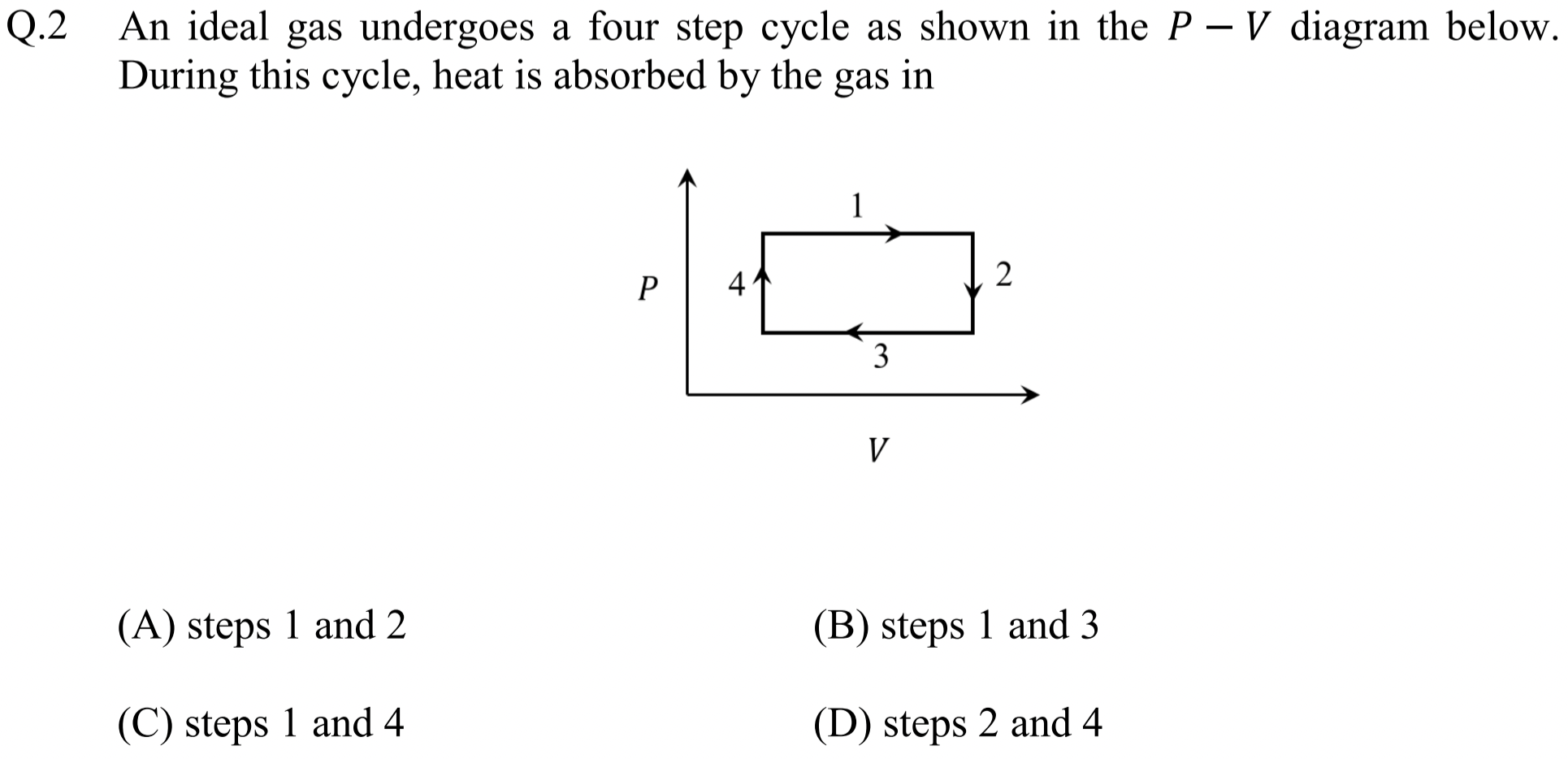
Use \(U=\frac{3}{2}nRT = \frac{3}{2}pV\) for internal energy and first law \(U_2 - U_1 = Q_\text{in} - \int_1^2 pdV\) to find sign of \(Q_\text{in}\) for each step.
where minus sign in the work integral takes care of energy loss by the gas in expansion. For internal energy of an (monatomic - not given in the problem) ideal gas we have the following for internal energy in a state \((n, p, V, T)\text{:}\)
\begin{equation*}
U = \frac{3}{2}n R T = \frac{3}{2}pV.
\end{equation*}
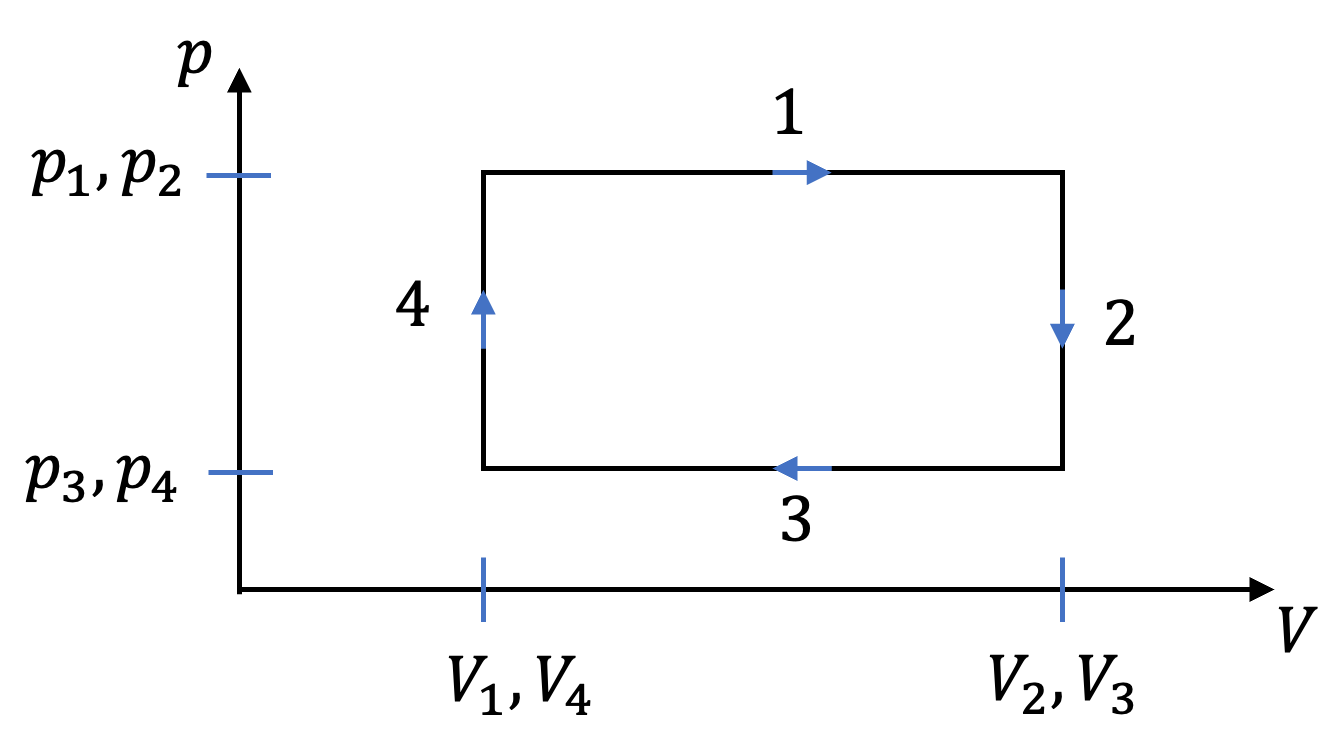
Now, we look at each process with notation for states as shown in Figure 3.1.3. States correspond to \((n,p,V,T)\) at the corners of the diagram are labeled with subscripts 1, 2, 3, 4.
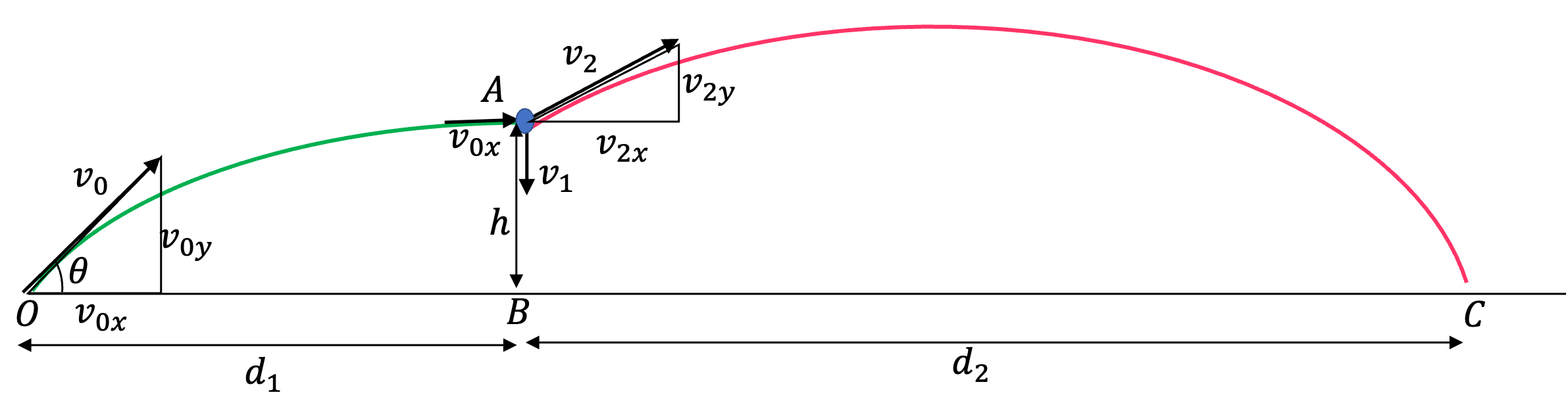
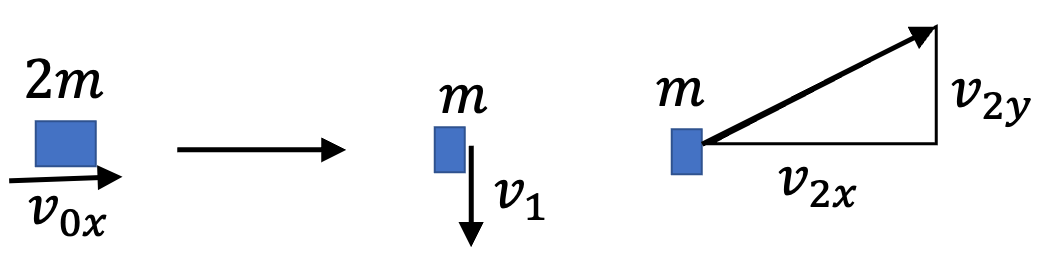
Strategy. Figure 3.1.7 shows the full extent of this problem. We have four processes (1) projectile motion O-to-A, (2) momentum conservation at A, (3) one-dimensional motion A-to-B, and (4) projectile motion A-to-C.
Here, initial velocity has magnitude \(v_1\) and direction down and acceleration is \(g\) pointed down. It covers a distance \(h=\frac{5}{4}\text{ m}\) found from O-to-A motion in time \(t_1=\frac{1}{2}\text{ sec}\text{.}\) Therefore,
\begin{equation*}
h = v_1 t_1 + \frac{1}{2}g t_1^2.
\end{equation*}
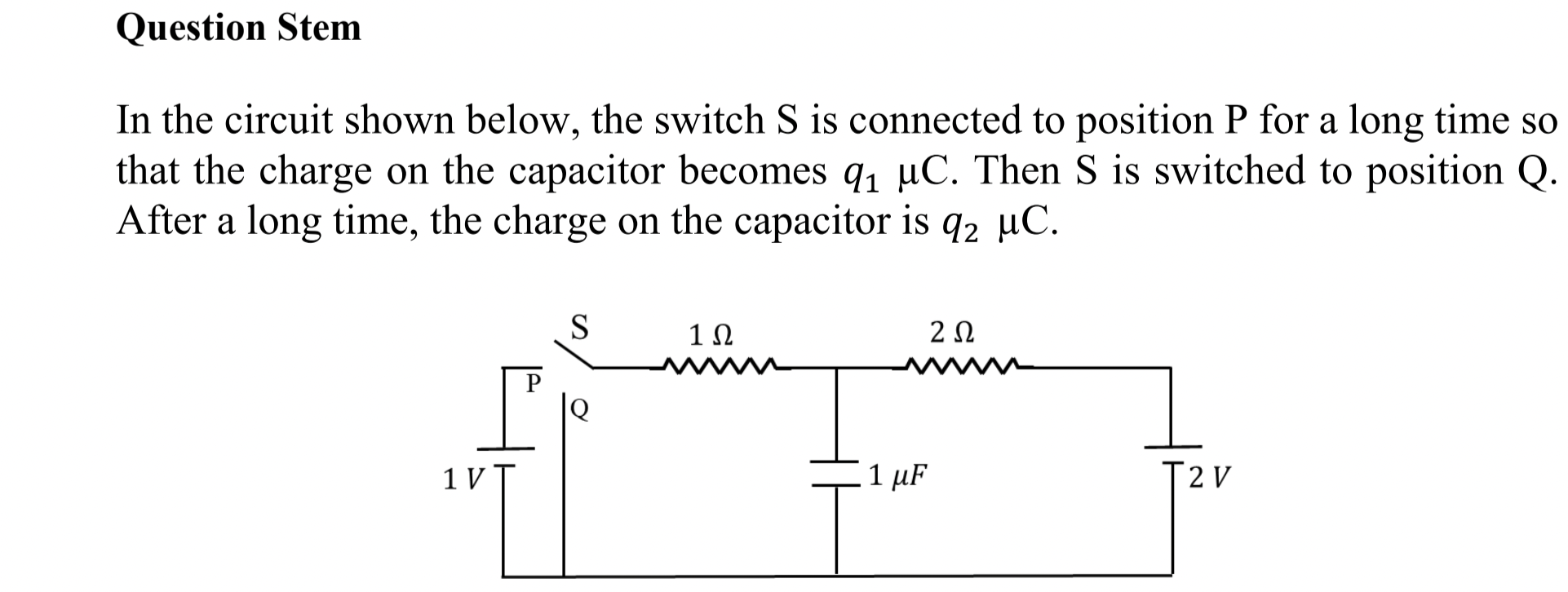
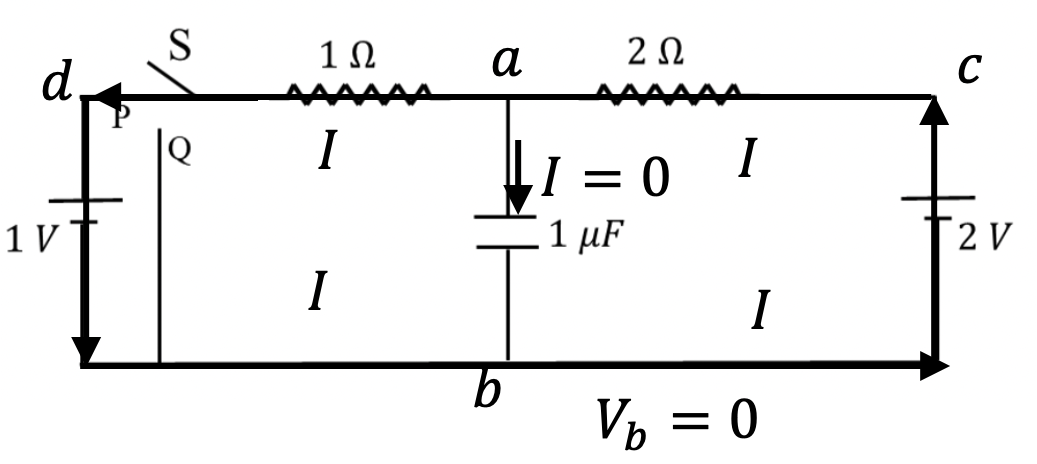
Since capacitor would be fully charged, there will be no current in the branch that has capacitor. Therefore, same current \(I\) will flow in the a-d-b-c-a circuit.
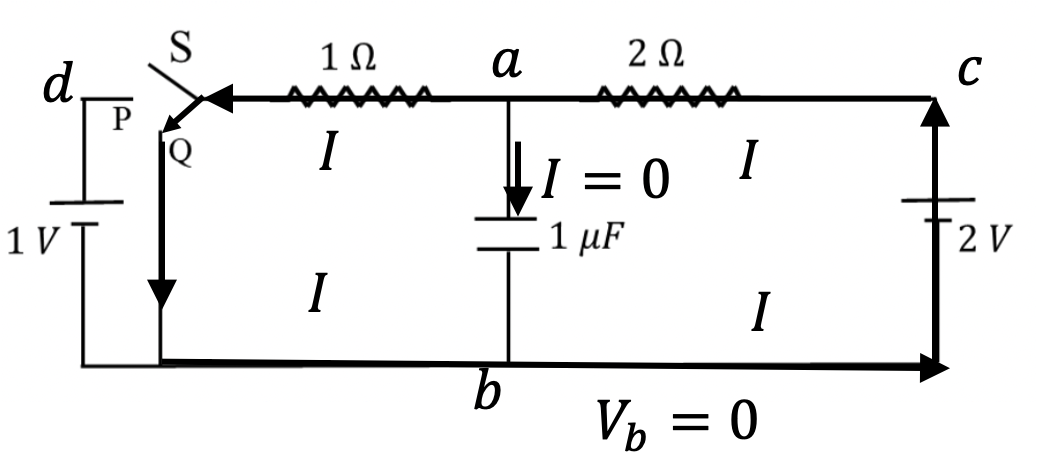
Again capacitor is fully charged, therefore, there will be no current in the branch that has capacitor. But now, the battery on the left is outside the circuit in which current flows as shown in Figure 3.1.11
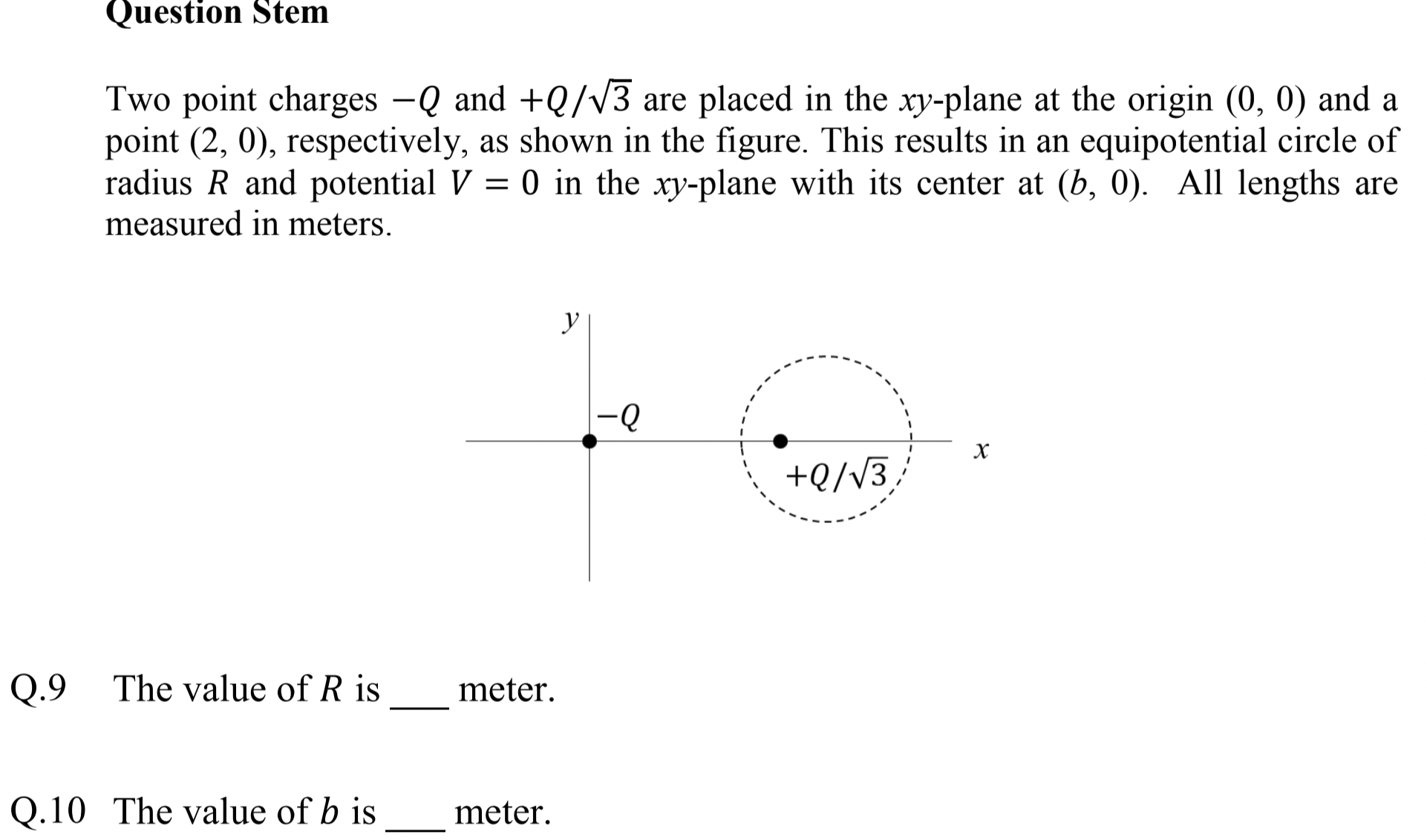
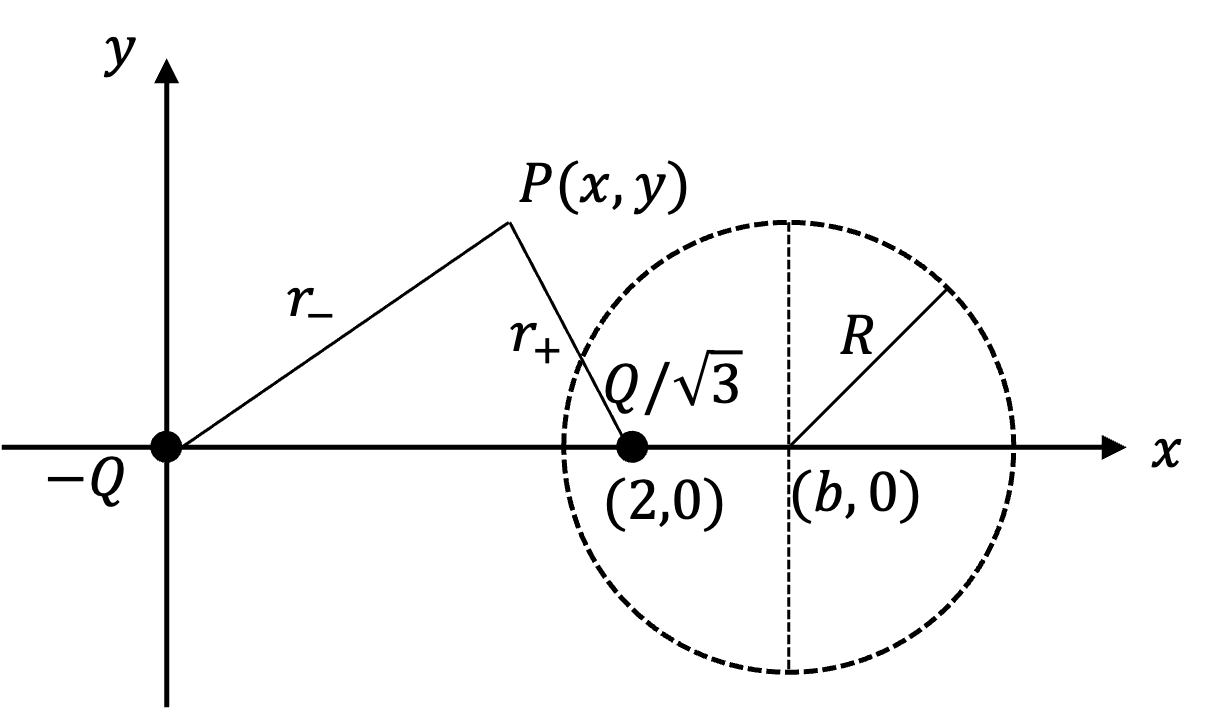
Strategy: I will write potential for general point in \(xy\)-plane and then demand that it be zero at all points of a sphere of radius \(R\) centered about \((b,0)\text{.}\) This should give necessary conditions. For this, we use Figure 3.1.13.
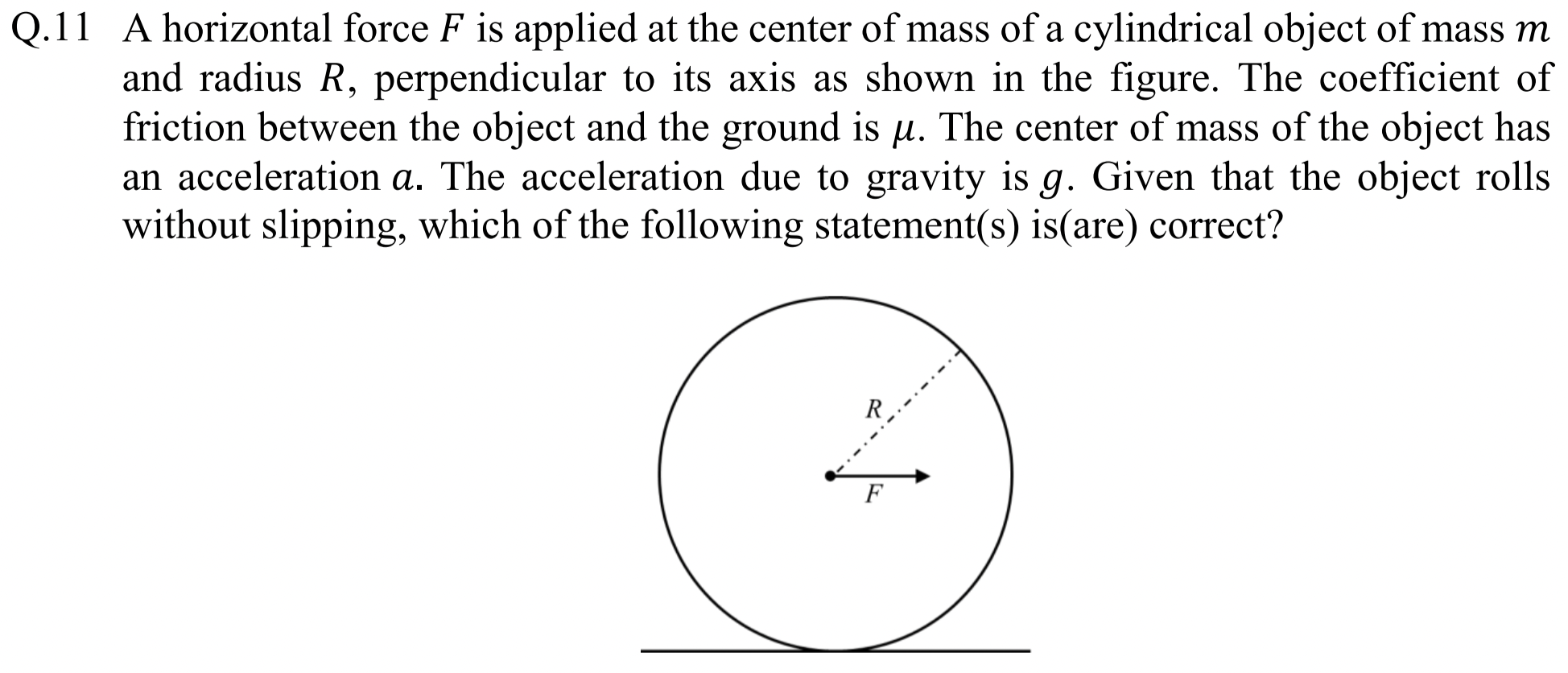
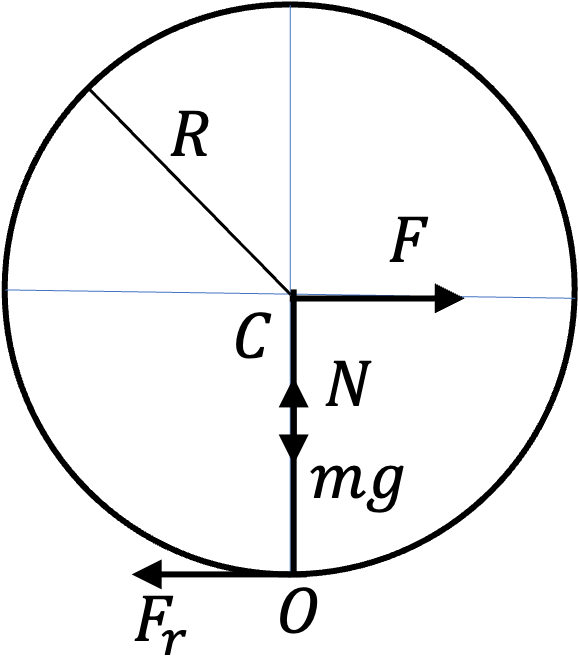
Using Figure 3.1.15, we can write equation of motion about the center as
\begin{equation*}
F_r R = I_0\alpha,
\end{equation*}
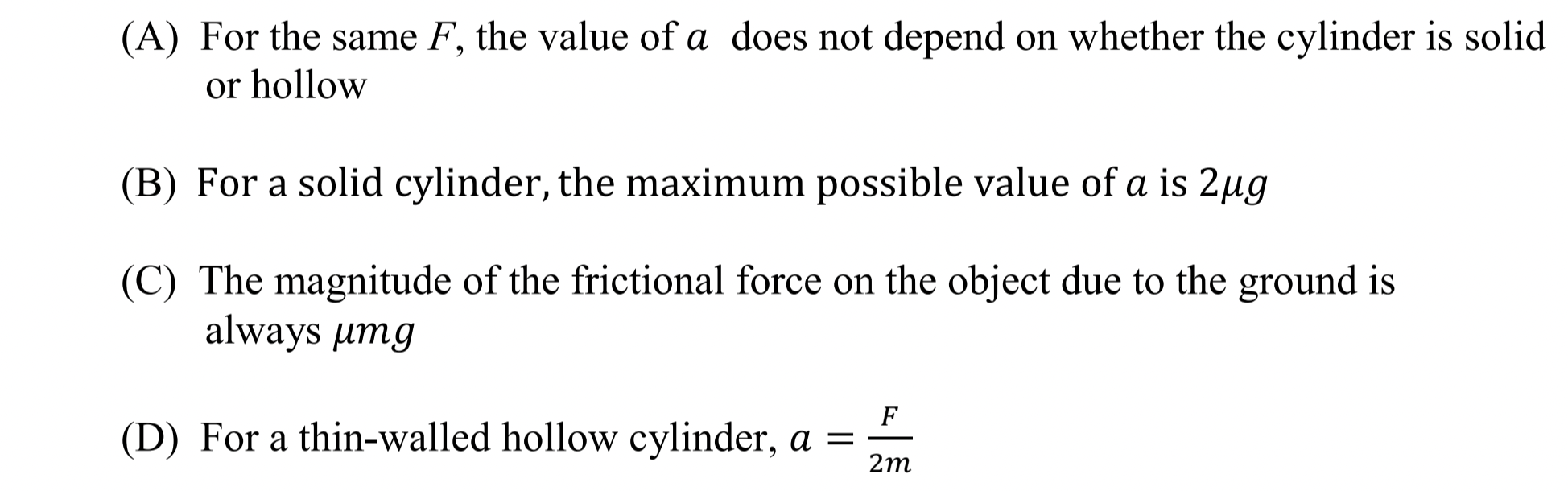
where \(I_0 = \frac{1}{2}mR^2\) is moment of inertia about the CM. Assuming maximum rolling friction, we will have \(F_r = \mu N\text{.}\) Since no acceleration of the CM in the vertical direction, we also have \(N-mg=0\text{.}\) Hence, acceleration of CM will be
\begin{equation*}
a = R\alpha = \frac{\mu mg R^2 }{ \frac{1}{2}mR^2 }= 2\mu g.
\end{equation*}
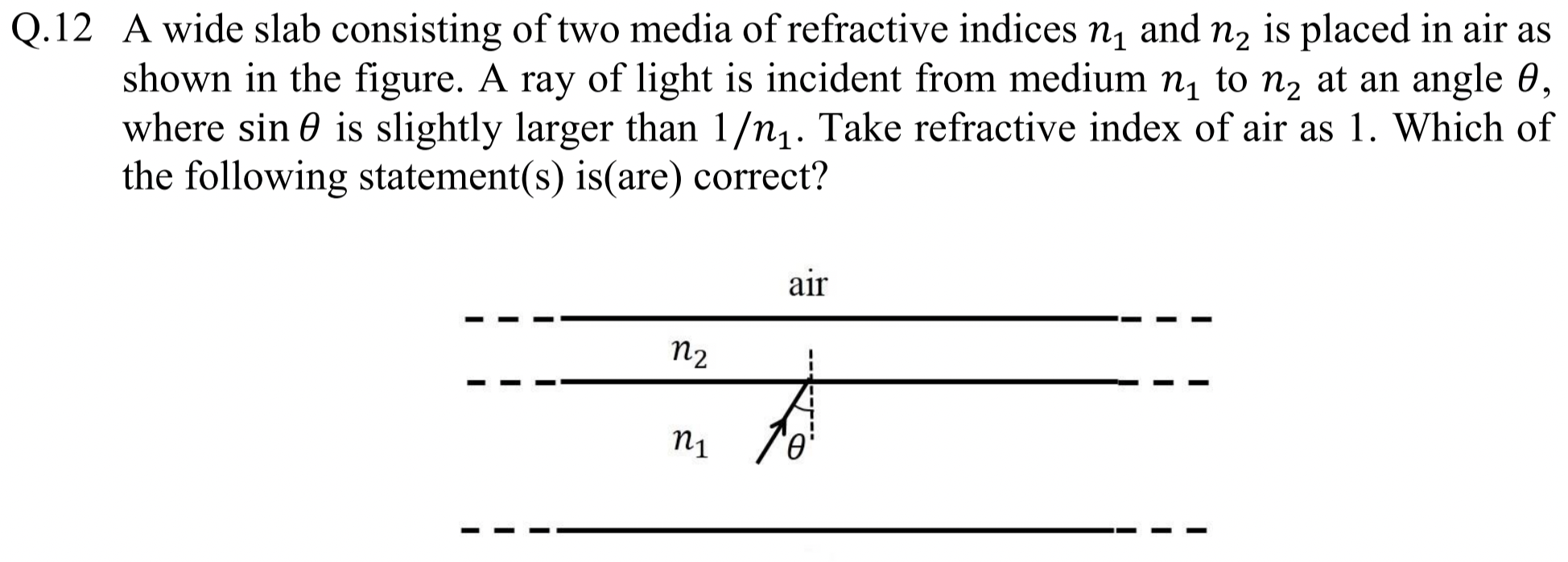
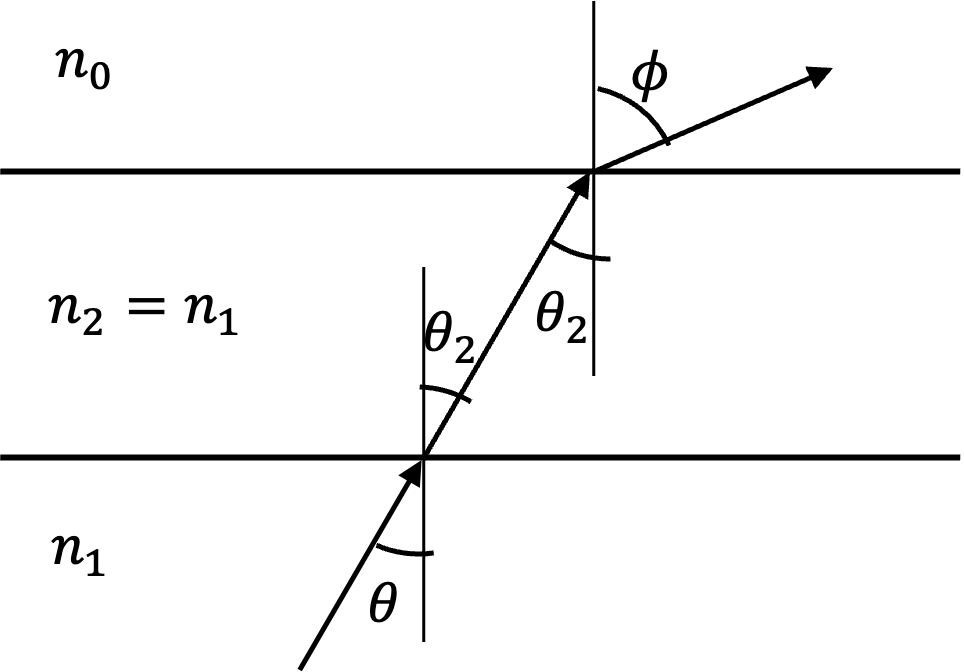
Main idea: \(x\) is not a real number if \(|\sin(x)| \gt 1\text{.}\) The incident ray in medium \(n_1\) has angle \(\theta\) such that \(\sin\theta \gt 1/n_1\text{,}\) i.e., \(n_1 \sin\theta \gt 1\text{.}\)
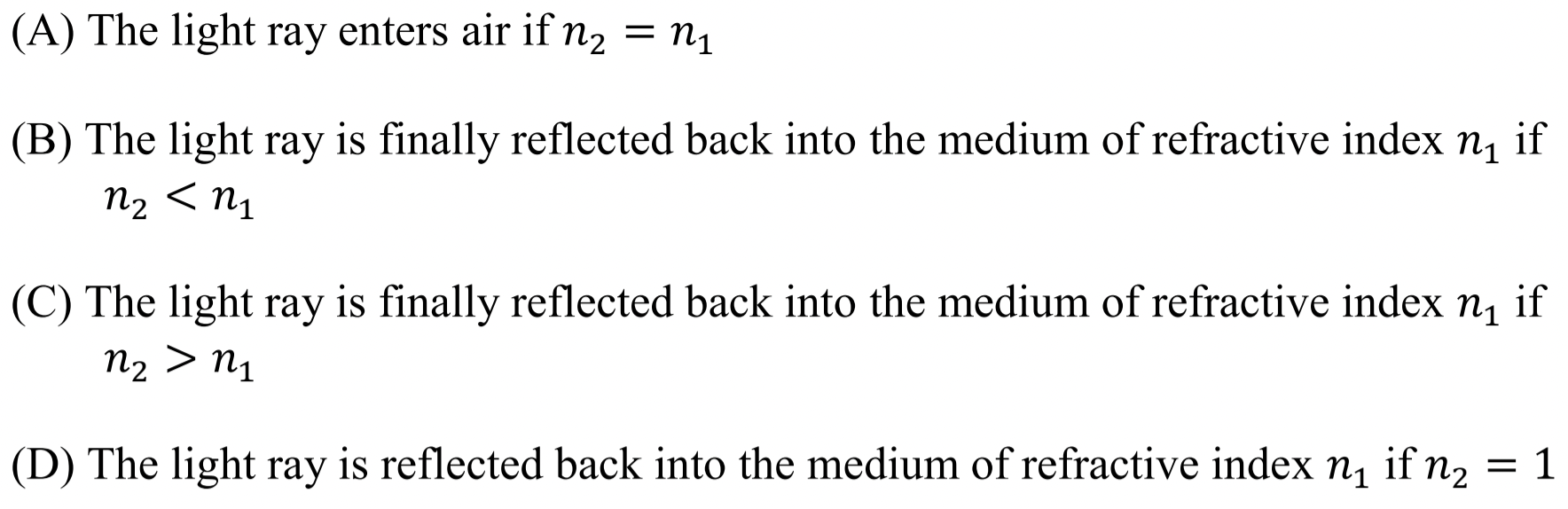
With \(n_0=1\) and \(n_1\sin\theta \gt 1\text{,}\) this will mean \(\sin\phi \gt 1\text{,}\) which is not possible for real \(\phi\text{.}\) Therefore (A) is incorrect.
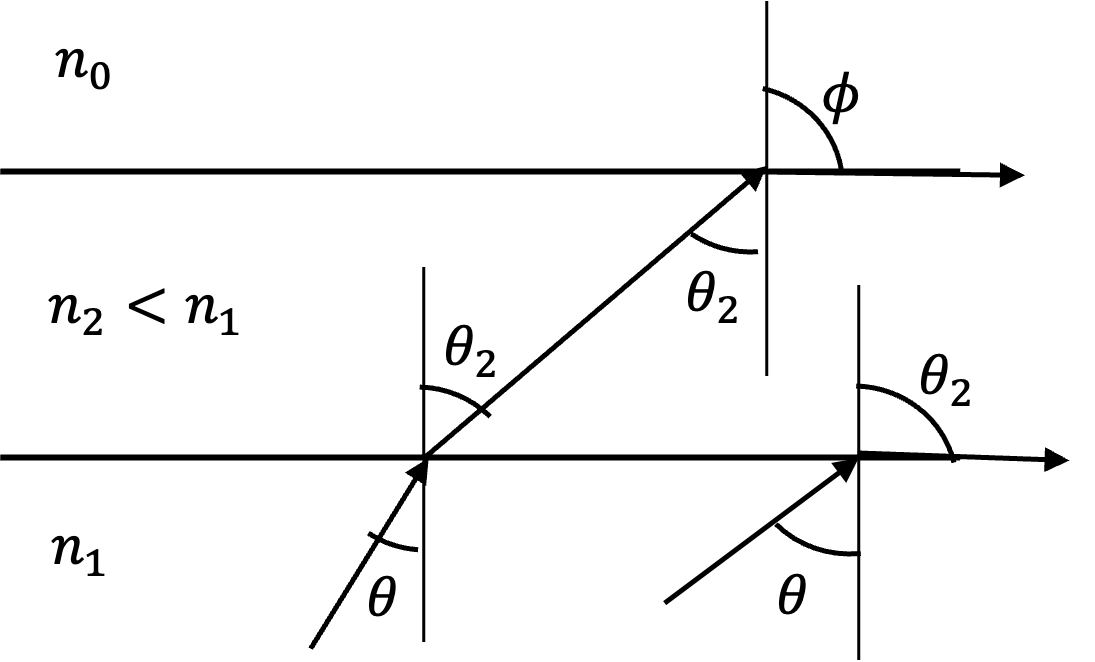
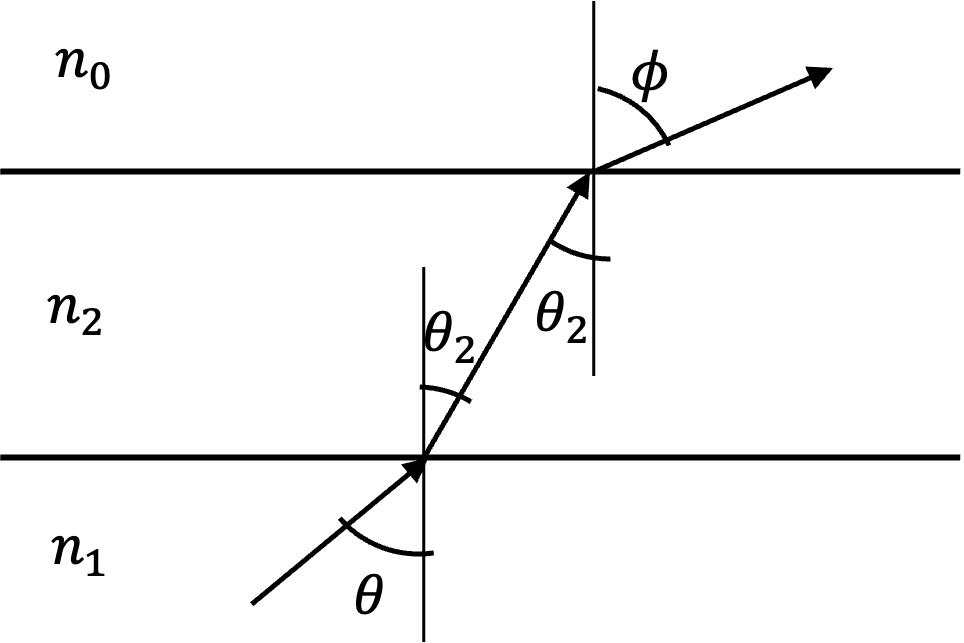
Choice (B) has case \(n_2 \lt n_1\text{.}\)Figure 3.1.18 shows two ways, ray from \(n_1\) can turn back into \(n_1\) wwithout any transmission into air. Another way to answer this question is to just look at the second of these:
Since \(n_2 \lt n_1\text{,}\) there would be some \(\theta\) at which this condition will have \(\sin\theta_2\gt 1\text{,}\) i.e., we wil lget total internal reflection back into \(n_1\text{.}\) Thus, (B) is correct.
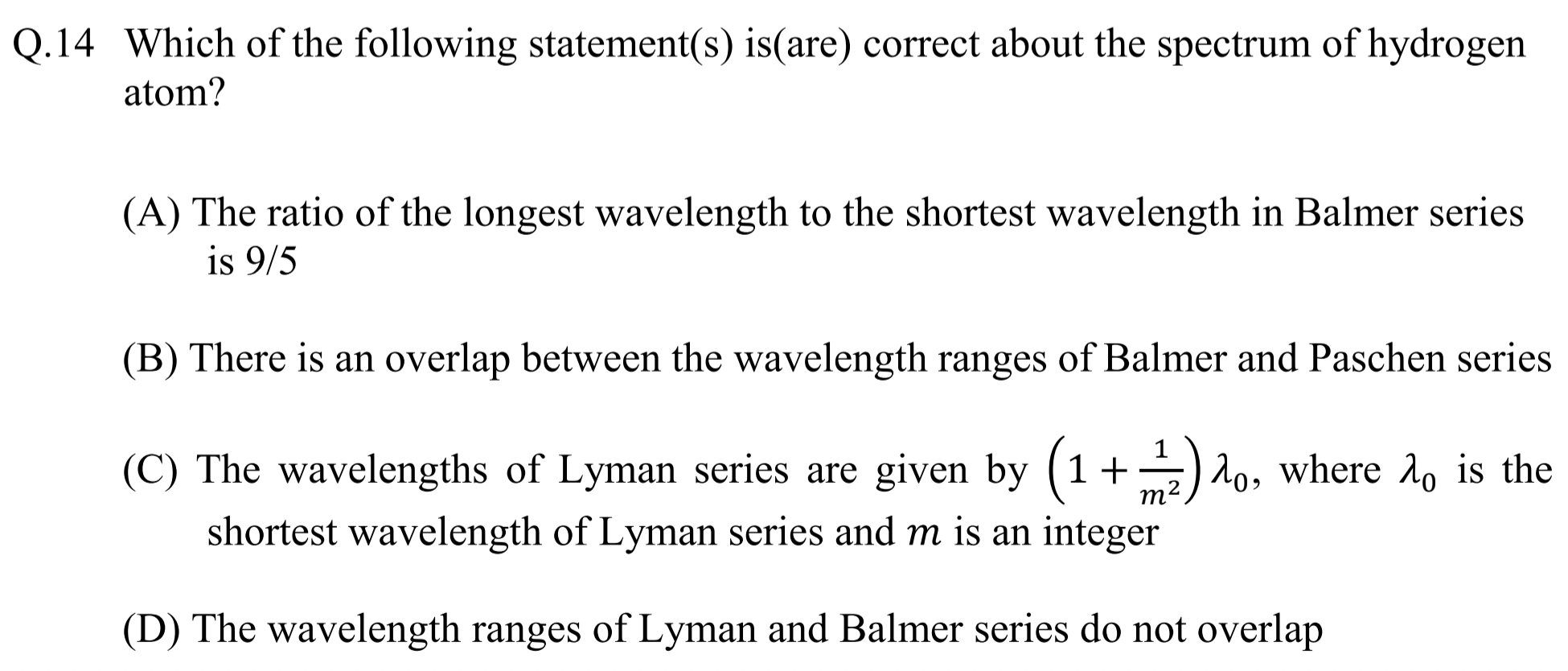
Paschen series is in general higher wavelengths than Balmer. Therefore, for (B), we need to just check whether min wavelength of Paschen series is smaller than max wavelength of Balmer.
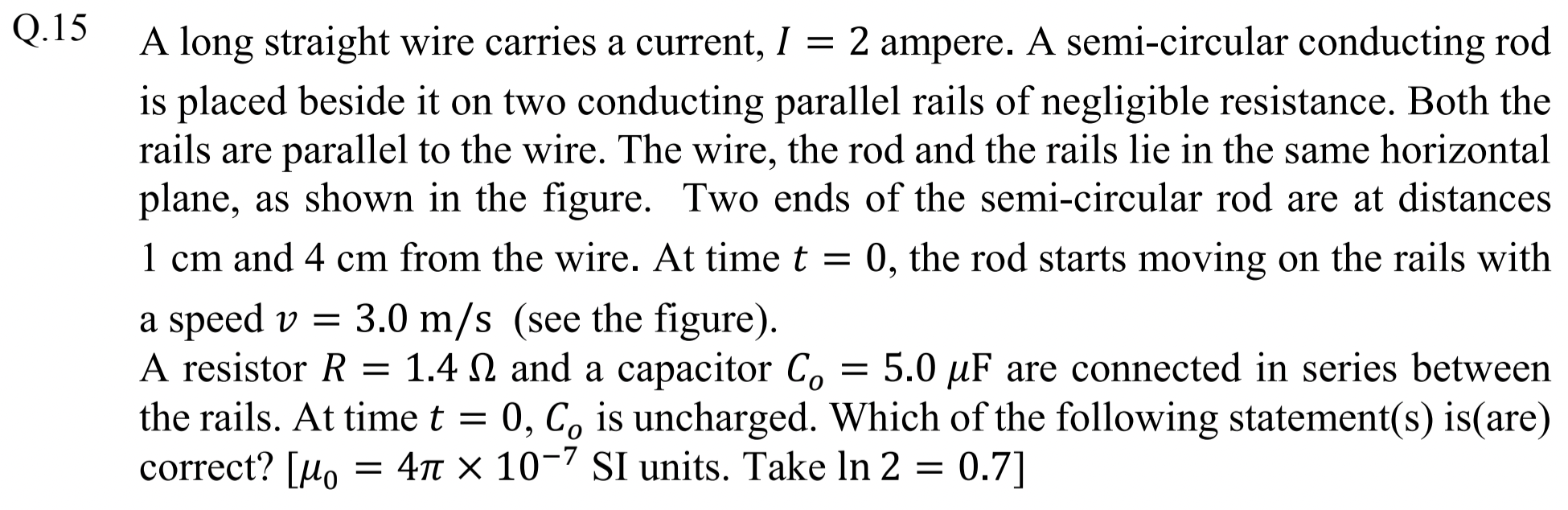
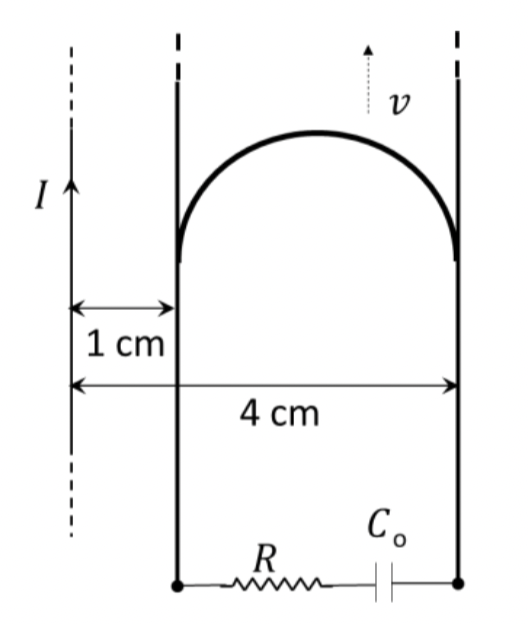
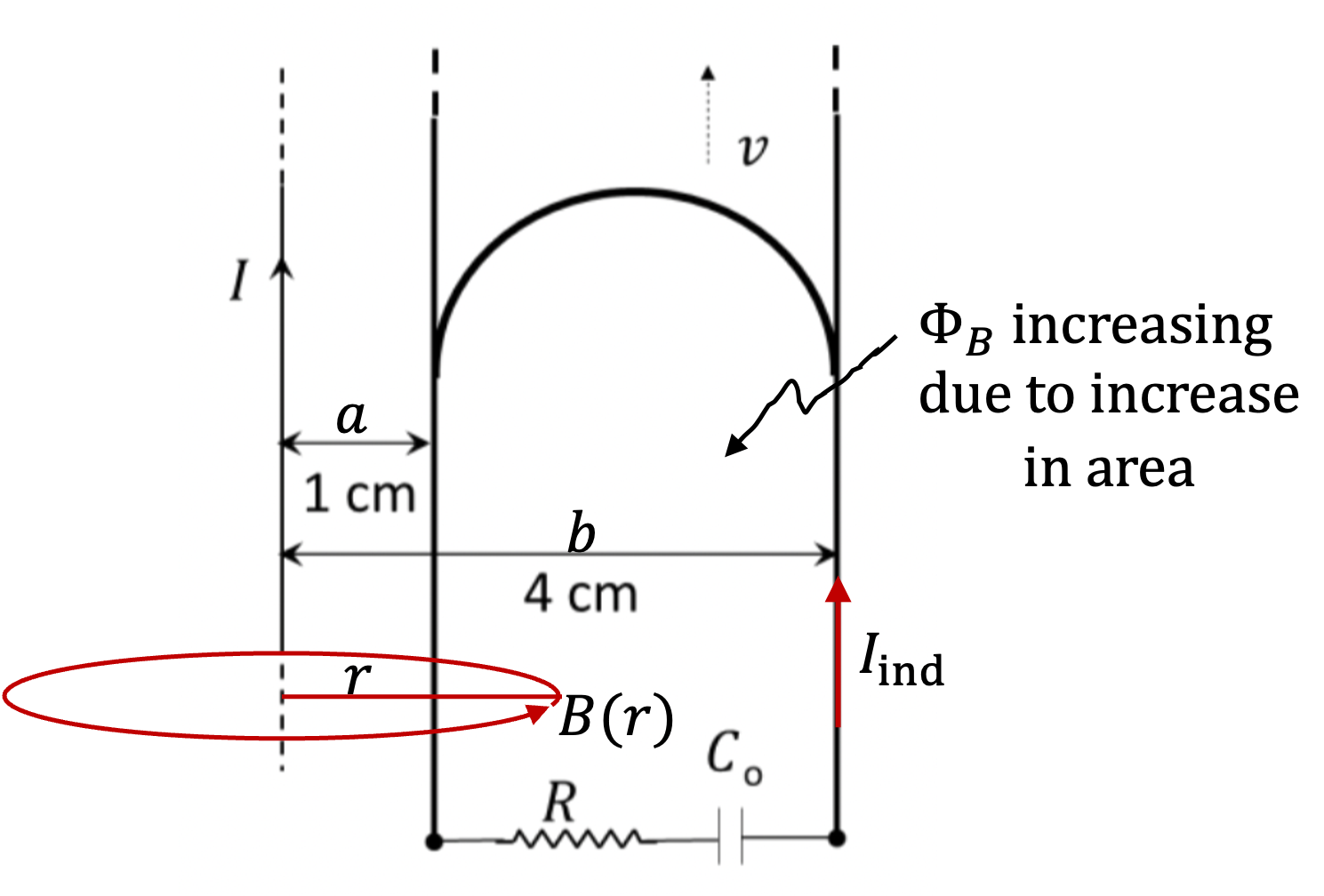
From Figure 3.1.24 we see that the magnetic field of the steady current \(I\) in the straight wire will pass through the area enclosed by the expanding circuit on the right. Hence, magnetic flux \(\Phi_B\) will change in the loop, which will cause induced current \(I_\text{ind}\text{.}\)
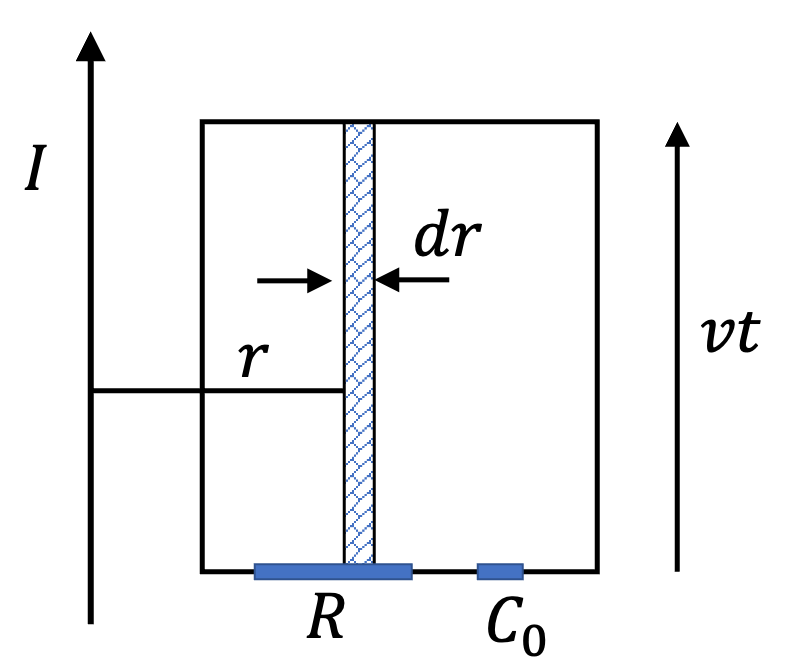
To calculate magnetic flux through the changing area, we write magnetic flux through a strip at a distance \(r\) as shown in Figure 3.1.25. This will be
\begin{equation*}
d\Phi_B = B(r)\, vt dr.
\end{equation*}
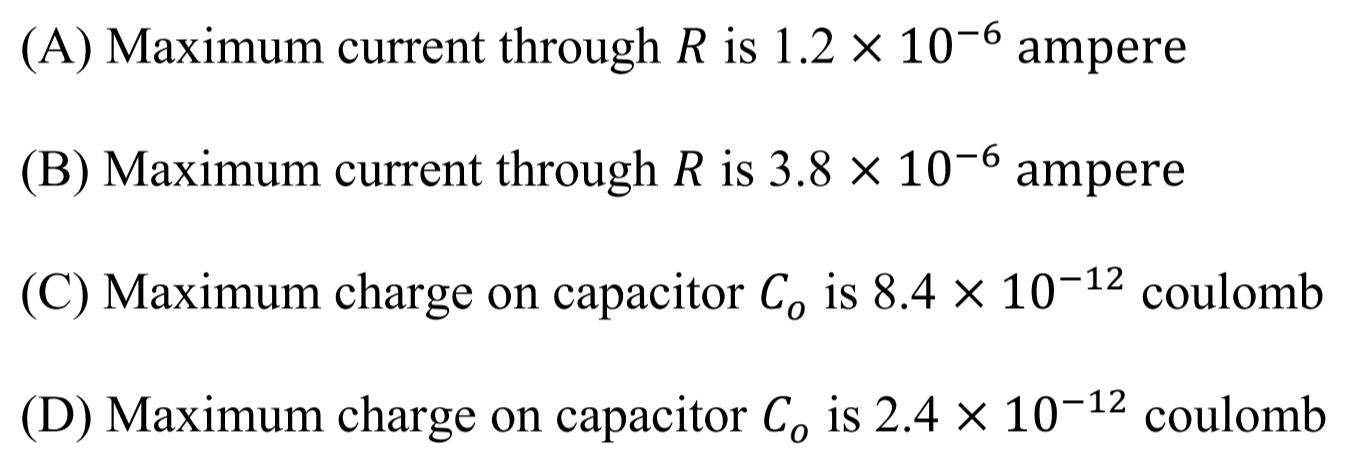
Now, notice that the loop acts as a charging RC-circuit with resistance \(R\text{,}\) capacitance \(C_0\) and EMF \(\mathcal{E}\text{.}\) Therefore, maximum current in this circuit will occur when all EMF falls around the resistor.
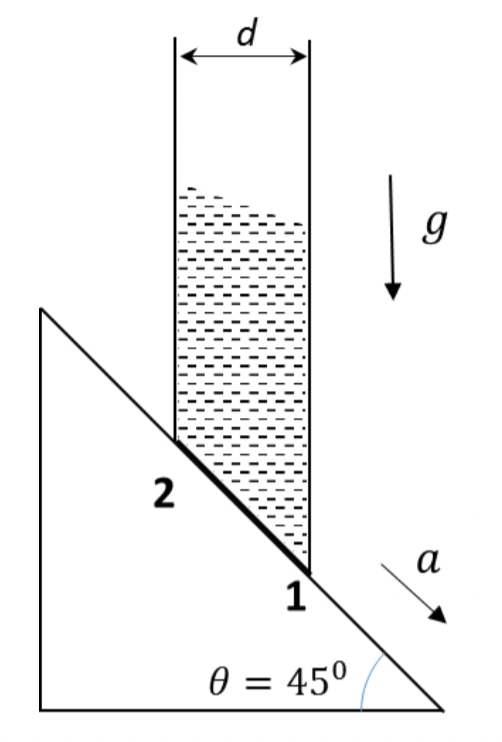
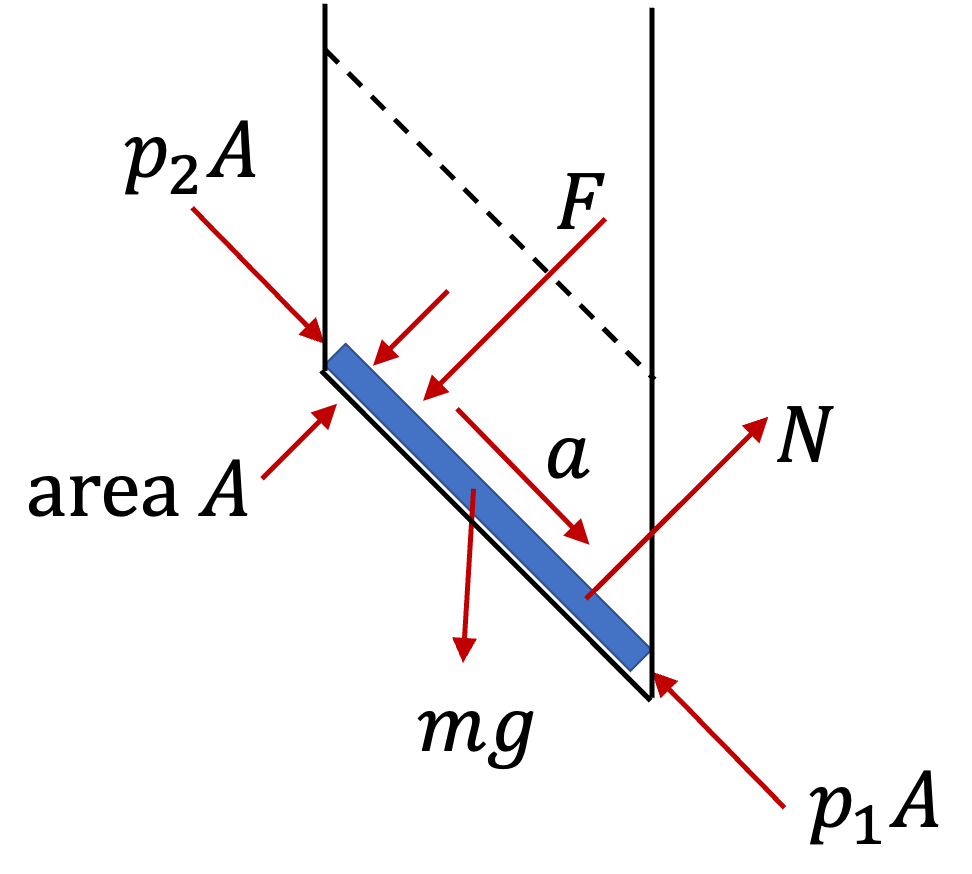
We examine an elment of water at the base with area of corss-section \(A\) and length \(d\sqrt{2}\text{.}\)Figure 3.1.27 shows forces \(mg\text{,}\)\(N\text{,}\)\((p_2-p_1)A\text{,}\) and \(F\text{.}\) As a result, the element has acceleration \(a\text{.}\)
For a particle of charge \(q\) and mass \(m\) moving with speed \(v\) in a circular orbit of radius \(R\) in a magentic field \(B\text{,}\) we will have
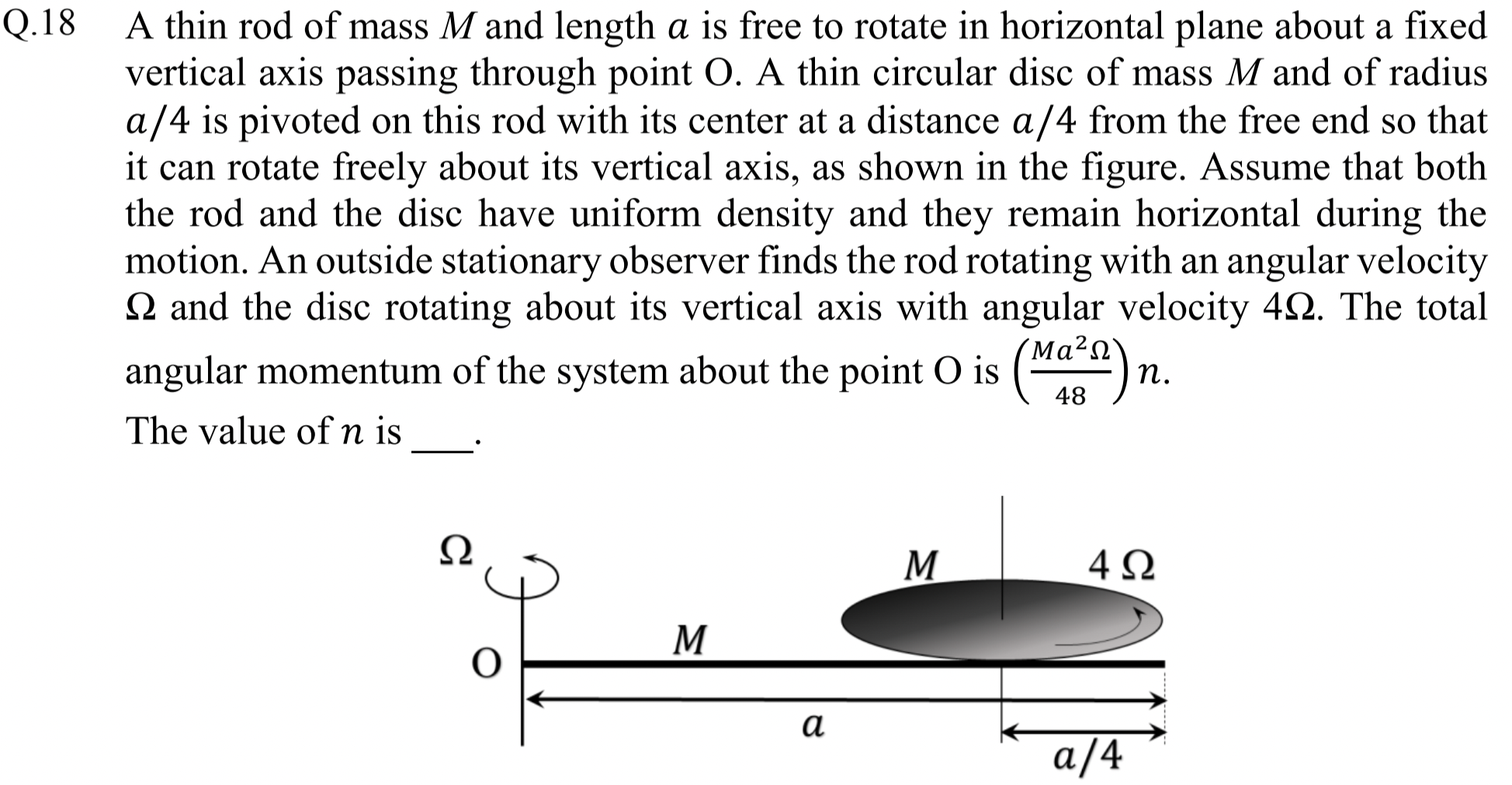
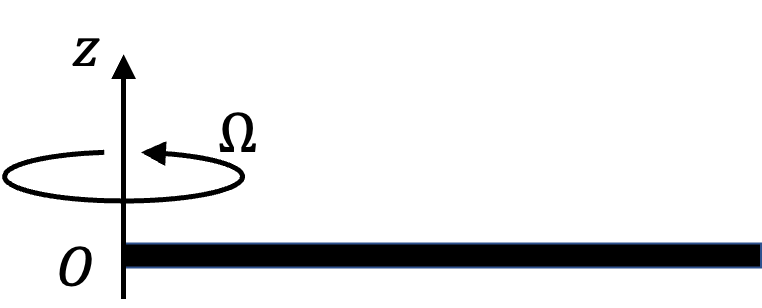
For rod, angular momentum will be \(I_\text{abt O}\Omega\) pointed towards positive \(z\)-axis. Since axis is at the end of the rod, we have \(I=ML^2/3\) formula.
\begin{equation*}
\vec L_\text{rod, abt O} = \frac{1}{3} M a^2 \Omega\, \hat k.
\end{equation*}
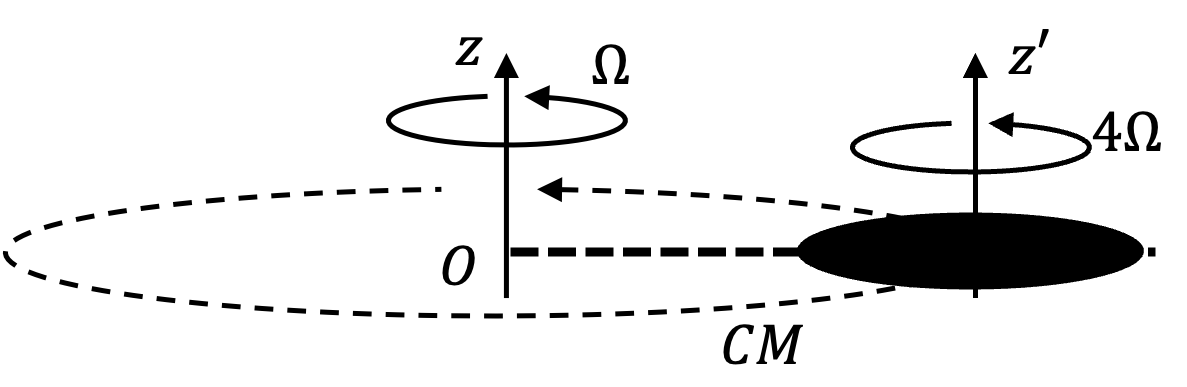
Now, the CM is located at a distance \(3a/4\) from O about which CM is moving in a circle with angular speed \(\Omega\) as shown in Figure 3.1.31. Therefore,
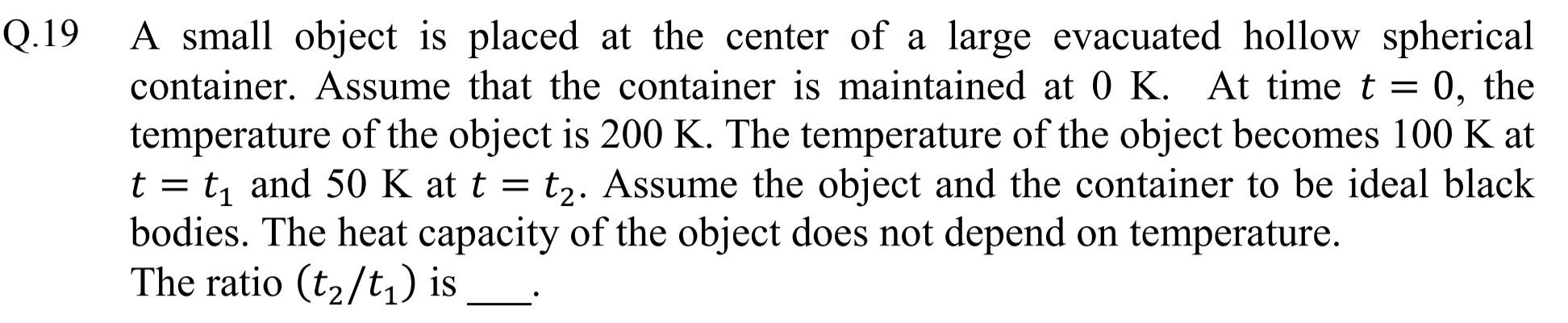
We will need two formulas for this problem. (1) One is the formula for power radiated from the object which is taken to be a blackbody at temperature \(T\) to the outer container kept at zero degree Kelvin.
\begin{equation*}
P = \sigma \epsilon A T^4,
\end{equation*}
where \(A\) is the surface area of the body, \(\epsilon\) its emissivity, and \(\sigma\) is a universal constant - we do not need values of these quantities for this problem since they will cancel out in the end. If hollow container was not at zero degree kelvin, it will also emit radiation, some of which will be absorbed by the body; in that case we would have \(P = \sigma \epsilon A T^4\)\(- \sigma a A T_\text{container}^4\text{,}\) but we do not have this here.
Since, body lose energy only by radiation, we can equate the rate of decrease of energy of the body to the rate of radiation of energy from the body to get the necessary equation for solving this problem.
\begin{equation*}
-mc\frac{dT}{dt} = \sigma \epsilon A T^4.
\end{equation*}