
Example 46.3. Reading Properties of Electromagnetic Wave from Electric Field Wave Function.
The electric field of an electromagnetic wave in vacuum is given by the following vector function of space and time, where \(y\) is in meters and \(t\) is in seconds.
\begin{equation*}
\vec E = \hat u_x\ 3\times 10^{5}(\text{N/C})\ \cos\left(2\pi\times 10^{15}\ t + k y + \frac{\pi}{2} \right),
\end{equation*}
where \(\hat u_x\) is a unit vector pointed towards positive \(x\) axis.
(a) Find the values of the frequency, wavenumber and wavelength of the wave.
(b) What is the direction of the travel of the wave? Find the propagation vector for the wave.
(c) Find the associated magnetic field wave.
Answer.
(a) \(f=10^{15}\text{ Hz}\text{,}\) \(k=2.09\times 10^{7}\text{ m}^{-1}\text{,}\) \(\lambda=3\times 10^{-7}\text{ m}\text{.}\) (b) \(\vec k = - 2.09\times 10^{7}\text{ m}^{-1} \hat u_y\text{.}\) (c) \(\vec B = \hat u_z 10^{-3}\text{ T} \cos\left( \pi\times 10^{15}\ t + 2.09\times 10^{7} y + \frac{\pi}{2} \right) \text{.}\)
Solution 1. (a)
From the phase part, i.e., the argument of the cosine, we read off the number multiplying time to get the angular frequency, \(\omega\text{.}\)
\begin{equation*}
\omega = 2\pi\times 10^{15}\text{ sec}^{-1}.
\end{equation*}
Dividing this by \(2\pi\) will give the cycles per sec or \(\text{Hz}\text{.}\)
\begin{equation*}
f = \frac{\omega}{2\pi} = 10^{15}\text{ Hz}.
\end{equation*}
Similarly, we readoff the wavenumber from the number that is multiplying the space, here \(y\text{.}\) We see that it is \(k\text{.}\) So, we need to think of another way of getting numerical value of \(k\text{.}\) We know that the product of frequency and wavelength is speed, we know for EM wave in vacuum. In terms of angular quantities this becomes
\begin{equation*}
\frac{\omega}{k} = c.
\end{equation*}
Therefore,
\begin{equation*}
k = \frac{\omega}{c} = \frac{2\pi\times 10^{15}\text{ sec}^{-1}}{3\times 10^8\text{ m/s}} = 2.09\times 10^{7}\text{ m}^{-1}.
\end{equation*}
We get wavelength \(\lambda\) from \(k\) by
\begin{equation*}
\lambda = \frac{2\pi}{k} = 3\times 10^{-7}\text{ m}.
\end{equation*}
Solution 2. (b)
By setting the argument of cosine to zero, we see that \(y/t \lt 0\text{.}\) This means the wave is traveling towards negative \(y\) axis. The popagation vector is product of the wavenumber and a unit vector along the direction of wave. Therefore,
\begin{equation*}
\vec k = - 2.09\times 10^{7}\text{ m}^{-1} \hat u_y,
\end{equation*}
where I have used the symbol \(\hat u_y\) for the unit vector in the direction of positive \(y\) axis. With negative multiplying the unit vector, the direction of \(\vec k\) is towards negative \(y\) axis.
Solution 3. (c)
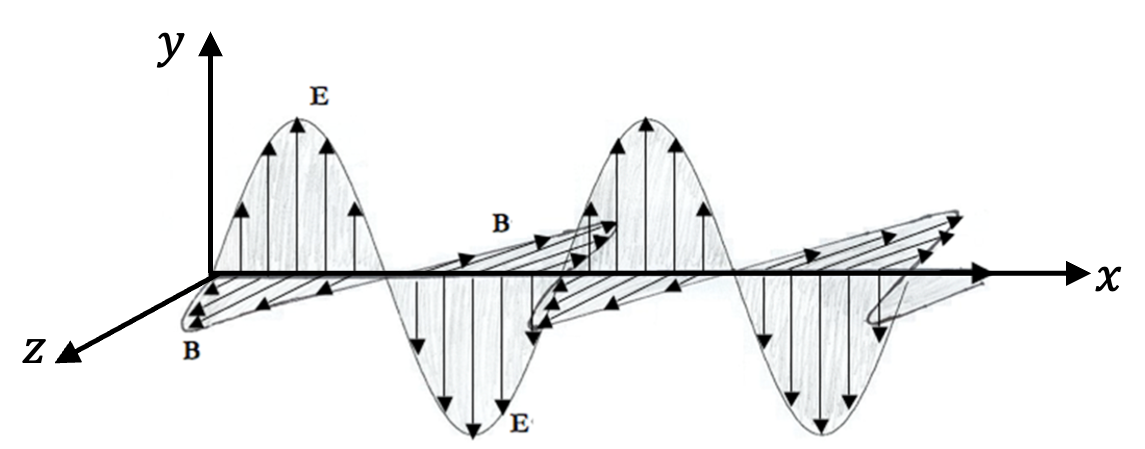
We need to obtain the direction of \(\vec B \) and magnitude of the amolitude \(B_0\text{.}\) Lets work out the direction first. The direction of \(\vec E\text{,}\) \(\vec B\text{,}\) and propagation vector \(\vec k\) are related for an EM wave.
\begin{equation*}
\text{ Direction of }\vec k \text{ is direction of } \vec E\times \vec B\text{ product}.
\end{equation*}
Now, use right hand to figure the direction of \(\vec B\) given that \(\vec E\) is towards positive \(x\) axis and \(\vec k\) is towards negative \(y\) axis. I got the direction of \(\vec B\) to be towards positive \(z\) axis.
The magnitude of \(B_0\) is \(E_0/c\text{,}\) therefore
\begin{equation*}
B_0 = \frac{E_0}{c} = \frac{3\times 10^{5}\text{ N/C}}{3\times 10^{8}\text{ m/s}} = 10^{-3}\text{ T}.
\end{equation*}
Therefore, magnetic field wave function is
\begin{equation*}
\vec B = \hat u_z 10^{-3}\text{ T} \cos\left( \pi\times 10^{15}\ t + 2.09\times 10^{7} y + \frac{\pi}{2} \right),
\end{equation*}
where I hae used \(\hat u_z\) for the unit vector pointed towards ppositive \(z\) axis.

